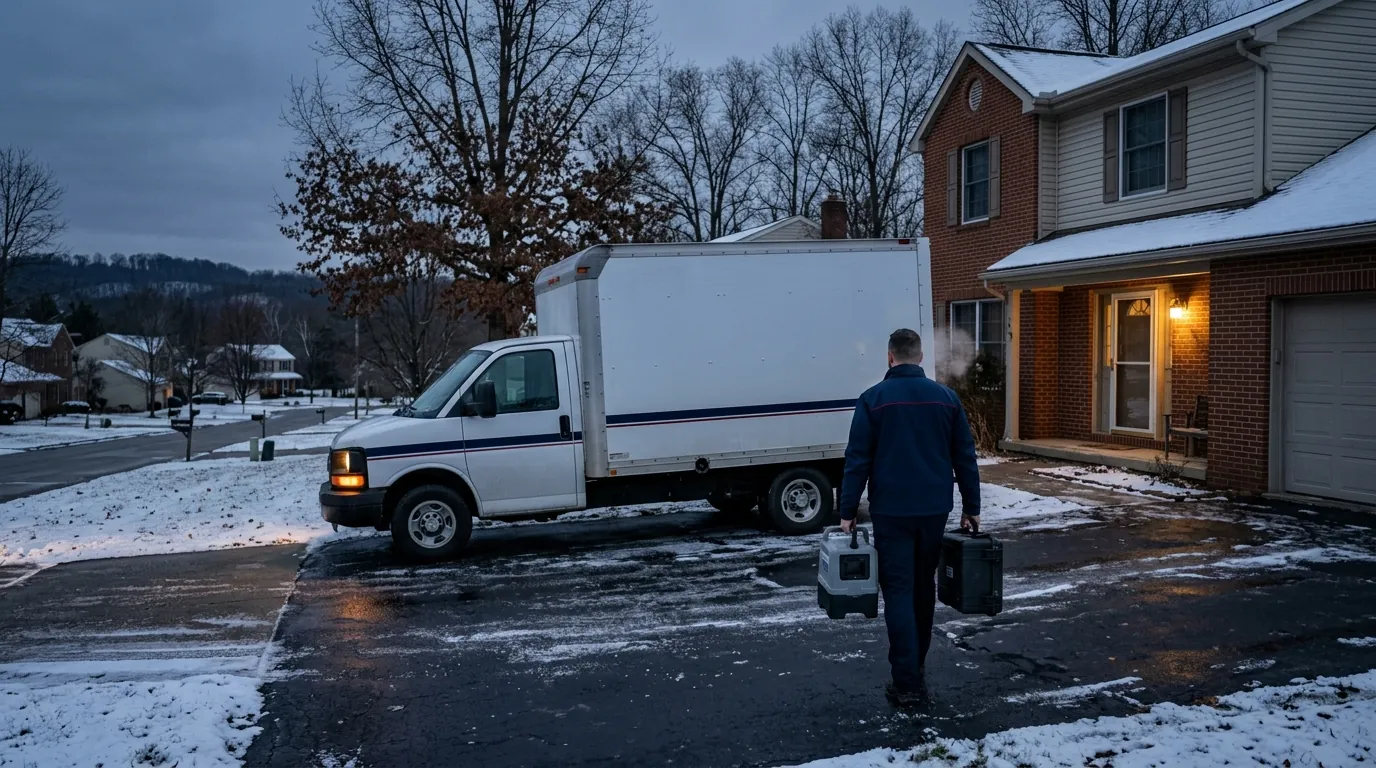
Smoke odor doesn’t come from the air — it comes from thousands of tiny particles that have embedded themselves into every porous surface in a room. That’s why opening windows and lighting candles doesn’t work, and why a house can still smell like a fire weeks after the flames are out. Professional smoke odor removal works because it targets those particles at the molecular level, using a combination of thermal fogging, hydroxyl or ozone generation, and encapsulants applied to structural materials. DIY methods almost always fail because they mask the odor at the surface while the source stays locked inside walls, subfloor, insulation, and HVAC ductwork.
Why Smoke Odor Is Harder to Remove Than It Looks
When something burns, it releases a complex mixture of gases, aerosols, and fine particulate matter. That mixture doesn’t just float in the air — it moves with heat and pressure, seeping into drywall, wood framing, carpet padding, upholstery foam, and even the inside of electrical outlets. As the smoke cools, those particles solidify onto surfaces in a thin, oily film called soot residue.
The chemistry matters here. Smoke from synthetic materials — plastics, foam, vinyl — produces a wet, sticky soot that penetrates deeply and carries some of the most persistent odor compounds. Smoke from wood or paper burns differently, leaving a drier, ashier residue that’s easier to clean from hard surfaces but still saturates soft goods and porous materials quickly.
Here’s the part most people don’t expect: the odor can intensify after the initial cleanup. Once humidity returns to normal levels, volatile organic compounds (VOCs) trapped in materials off-gas back into the living space. That’s why a room that smelled manageable right after a fire can smell worse two weeks later on a warm, humid Pennsylvania afternoon.
What Professionals Actually Do — Step by Step
A trained smoke restoration crew doesn’t start with deodorizers. They start with assessment and containment, then work through a deliberate sequence:
-
Scope and document the affected area. Technicians identify the burn origin, map how far smoke traveled through the structure (including HVAC pathways), and photograph everything for insurance documentation.
-
Remove unsalvageable materials. Drywall, insulation, carpet, and soft goods that have absorbed heavy soot are often demolished rather than cleaned — not because cleaning is impossible, but because the labor cost exceeds replacement cost and the odor risk is too high to leave them in place.
-
Dry-clean and HEPA-vacuum all surfaces. Before any wet cleaning, loose soot is removed with dry chemical sponges and HEPA-filtered vacuums. Wet-wiping loose soot first smears it deeper into porous surfaces.
-
Apply professional-grade cleaning agents. Alkaline cleaners cut through the oily soot film on hard surfaces. Enzyme-based products break down protein-based smoke compounds. These are not products available at a hardware store.
-
Thermal fog or hydroxyl treatment. Thermal fogging uses a petroleum-based deodorizer heated into a fog that mimics the behavior of smoke — it penetrates the same cavities the smoke entered and neutralizes odor compounds on contact. Hydroxyl generators produce UV-activated hydroxyl radicals that oxidize odor molecules in the air and on surfaces without requiring the space to be vacated (unlike ozone, which requires evacuation and careful timing).
-
Seal structural surfaces. After cleaning, exposed framing, subfloor, and drywall backing are sealed with an odor-blocking encapsulant — typically a shellac-based or specialized latex primer — to lock in any remaining compounds before reconstruction begins.
-
Clean or replace HVAC components. If smoke traveled through the duct system, the ducts, air handler, and filter media need professional cleaning. Skipping this step means the system will redistribute odor every time it runs.
Why DIY Usually Fails
The most common DIY approaches — ozone machines rented from a hardware store, baking soda, odor-eliminating sprays, and “smoke eliminator” candles — share a fundamental problem: they work on the air, not on the source.
Rented ozone machines are the closest thing to a professional tool available to consumers, but they’re frequently misused. Effective ozone treatment requires a specific concentration held for a specific duration, then complete ventilation before re-entry. Most renters don’t achieve the right concentration, don’t run the unit long enough, and don’t address the surfaces that are actually holding the odor. The smell returns within days.
Paint is another common mistake. Painting over soot without proper cleaning and sealing first traps moisture and odor compounds against the wall. Within weeks — sometimes days — the smell bleeds back through the new paint, and now you have a cleaning problem underneath a fresh coat that has to be removed.
Cleaning products marketed as smoke odor eliminators typically contain masking fragrances. They work briefly, then the fragrance dissipates and the original odor reasserts itself. In some cases the fragrance compounds interact with the soot chemistry and produce a smell that’s harder to describe and harder to remove than the original smoke odor.
The honest answer is that DIY is appropriate for very minor smoke exposure — a small kitchen fire contained to one room, for example, where the smoke was mostly water vapor and didn’t penetrate deeply. For anything involving structural materials, HVAC exposure, or synthetic-material combustion, professional equipment and chemistry are not optional.
When to Call a Professional
Call a restoration company — not just a cleaning service — when any of the following are true:
- The fire involved more than a single small appliance or contained cooking incident
- You can smell smoke in rooms that weren’t near the fire
- The HVAC system was running during or after the fire
- You’ve tried cleaning and the smell returned within a week
- There is visible soot on walls, ceilings, or inside cabinets
- The structure has any soft goods (carpet, upholstery, insulation) that were in the affected area
- Your insurance adjuster is involved — professional documentation protects your claim
In Cranberry Township and the surrounding Butler County area, homes tend to be a mix of newer construction with open floor plans and older ranches and colonials with more compartmentalized layouts. Open floor plans are particularly vulnerable to smoke migration because there are fewer barriers to stop it from reaching every room.
The Longer Recovery: What Comes After Odor Removal
Successful odor removal is a prerequisite to reconstruction, not the end of the process. Once surfaces are cleaned and sealed, the work shifts to replacing what was removed — drywall, insulation, flooring, cabinetry — and restoring the space to its pre-loss condition.
This is where a company that handles both smoke odor remediation and full fire damage restoration has a real practical advantage: the same crew that documented the damage, removed the affected materials, and treated the structure can manage the rebuild without a handoff gap where things get missed or miscommunicated.
Insurance carriers generally cover professional smoke remediation when the loss is documented properly. Keeping records of what was cleaned, what was removed, what treatments were applied, and what materials were used for reconstruction is essential — both for your claim and for any future disclosure if you sell the property.
If you’re dealing with smoke odor that hasn’t responded to cleaning, or you want a professional assessment of how far smoke traveled through your home, FireDEX Butler serves Cranberry Township and the broader Butler County area. Reach out at (724) 452-7400 to talk through what you’re seeing and whether a professional evaluation makes sense for your situation.