Water Damage Restoration in Cranberry Township
24/7 water damage restoration in Cranberry Township and surrounding areas. Insurance billing accepted. Call (724) 452-7400.
What happens in the first 48 hours matters more than most homeowners realize
You notice a wet carpet at 7 a.m. By noon, gypsum board has begun to soften. By the following morning, if conditions are right, microbial growth can take hold in wall cavities you can’t see. Water damage isn’t a static event — it’s a countdown. The difference between a straightforward extraction-and-dry job and a full gut-and-rebuild often comes down to how quickly moisture is measured, contained, and removed from the structure.
What water damage restoration actually involves
Water damage restoration is a technical, equipment-intensive process — not just running a shop vac and setting fans. The work begins with identifying the water category. Category 1 is clean supply-line water; Category 2 carries contaminants from appliance overflow or washing machine discharge; Category 3 — sewage backup, floodwater, or anything that’s been sitting — requires containment protocols and PPE before extraction begins.
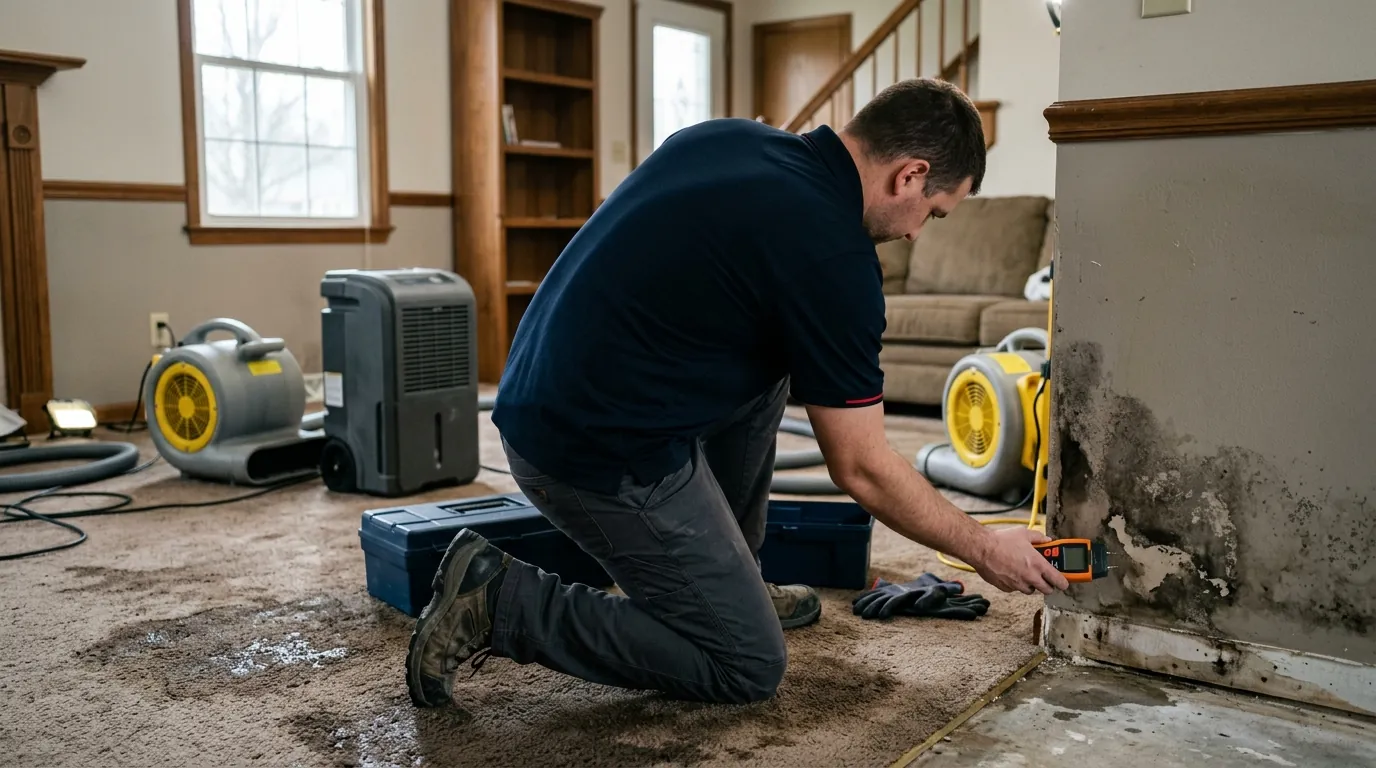
Once the category is established, the focus shifts to extraction. Truck-mounted extractors can pull hundreds of gallons from flooring assemblies, subfloor, and carpet padding in a single visit. After standing water is gone, the harder work starts: structural drying. Industrial-grade desiccant or refrigerant dehumidifiers draw moisture out of framing, drywall, and concrete slabs, while air movers accelerate evaporation at the surface. Drying times in western Pennsylvania’s humid climate typically run three to five days for Category 1 losses in a single room, longer for multi-floor events or Category 2/3 situations.
Throughout the drying phase, calibrated moisture meters and thermal imaging cameras track progress inside wall cavities and under flooring — places where moisture hides long after surfaces feel dry to the touch. Equipment is adjusted daily based on readings, not on a fixed schedule.
Our process
-
Emergency response and safety assessment. We respond around the clock. Before any equipment goes in, we confirm the source is stopped, check for electrical hazards, and classify the water category. A Category 3 loss changes every step that follows.
-
Water extraction. Truck-mounted and portable extractors remove standing water from all affected surfaces — carpet, hardwood, tile, concrete, and crawl spaces. Carpet padding is almost always non-salvageable and is removed at this stage; attempting to dry it in place traps moisture under the floor and extends drying time significantly.
-
Structural drying setup. Dehumidifiers and air movers are placed according to a drying plan calculated from the affected square footage, material types, and ambient conditions. In a typical Cranberry Township ranch home, a contained basement water loss might require three to five dehumidifiers and eight to twelve air movers running continuously.
-
Daily moisture monitoring. A technician returns each day to log moisture readings at mapped locations throughout the structure. Readings are documented — this data becomes part of the insurance claim file. Equipment is repositioned or added based on what the numbers show, not on what the surface looks or feels like.
-
Clearance and documentation. Drying is complete when affected materials reach established dry standards — not when they seem dry. Final moisture readings are logged, photographs are taken, and a drying report is compiled. This report is what your insurance adjuster uses to verify the scope of work.
What separates a good water damage response from a bad one
The most common mistake in water damage work is pulling equipment too early. A wall cavity that reads elevated moisture on day two may read normal on day three — then spike again on day four as moisture migrates from deeper in the assembly. Operators who pull dehumidifiers on a fixed three-day schedule rather than monitoring actual readings leave moisture behind. That moisture becomes a mold problem in two to three weeks, and the adjuster will note the gap in documentation.
A second failure point is ignoring secondary spaces. Water follows gravity and air pressure differentials. A second-floor bathroom leak almost always affects the ceiling assembly below, and frequently reaches wall cavities one or two rooms away. Experienced technicians use thermal imaging to map the actual migration path, not just the visible wet area.
On the insurance side, adjusters look for a complete drying log with daily moisture readings at consistent mapped locations, photographs of equipment placement, and a moisture map showing the affected perimeter. Claims without this documentation are frequently underpaid or disputed.
Seasonal and regional considerations
Western Pennsylvania’s freeze-thaw cycle creates a predictable spike in water losses from January through March. Pipes in exterior walls and uninsulated crawl spaces — common in the older housing stock throughout Butler County — are the most frequent source. When temperatures drop sharply after a warm stretch, supply lines that have never failed before can split overnight.
Spring brings a second wave: sump pump failures during heavy rain events and foundation seepage as snowmelt saturates the soil. Cranberry Township’s clay-heavy soils drain slowly, which means hydrostatic pressure against basement walls stays elevated for days after a storm. If your sump pump is more than seven years old and hasn’t been tested recently, it’s worth checking before the next hard rain.
Summer humidity in the region — regularly above 70% — means structural drying takes longer than it would in a drier climate. Equipment that would dry a space in three days in Arizona may need five or six here.
Service area
FireDEX Butler is based in Cranberry Township and handles water damage restoration throughout Butler County and the surrounding region, including Mars, Zelienople, Evans City, Saxonburg, and communities throughout the North Hills of Pittsburgh. The city-specific pages linked from this site cover local response details for each area.
If you’re standing in a wet room right now, call (724) 452-7400. We’re available around the clock, and the sooner extraction begins, the more of your structure — and your claim — we can protect. Schedule your moisture assessment today.
Frequently Asked Questions
How long does structural drying typically take, and what affects that timeline?
What's the difference between Category 1, 2, and 3 water, and does it change what you do on-site?
Can hardwood floors be saved after water damage, or do they always need to be replaced?
What should I do while waiting for the restoration crew to arrive?
How does daily moisture monitoring affect my insurance claim?
Looking for the best water damage restoration company in Cranberry Township?
FireDEX Butler provides licensed and insured water damage restoration in Cranberry Township, PA and the surrounding area, and has served local property owners since 1981. We answer calls 24/7 — call (724) 452-7400 for immediate help.
Need Water Damage Restoration now?
We respond 24/7 across Cranberry Township and surrounding PA cities.
Related Coverage
- Our Restoration Services
- Contact FireDEX Butler
- Water Damage Restoration in Beaver Falls
- Water Damage Restoration in Butler
- Water Damage Restoration in Cranberry Township
- Water Damage Restoration in Evans City
- Water Damage Restoration in Gibsonia
- Water Damage Restoration in Mars
- Water Damage Restoration in Seven Fields
- Water Damage Restoration in Wexford
- Water Damage Restoration in Zelienople
- Burst Pipe Emergency Checklist: Step-by-Step Response
- What To Do in the First 24 Hours After Water Damage
- How To Choose a Restoration Company in (Without Getting Burned)