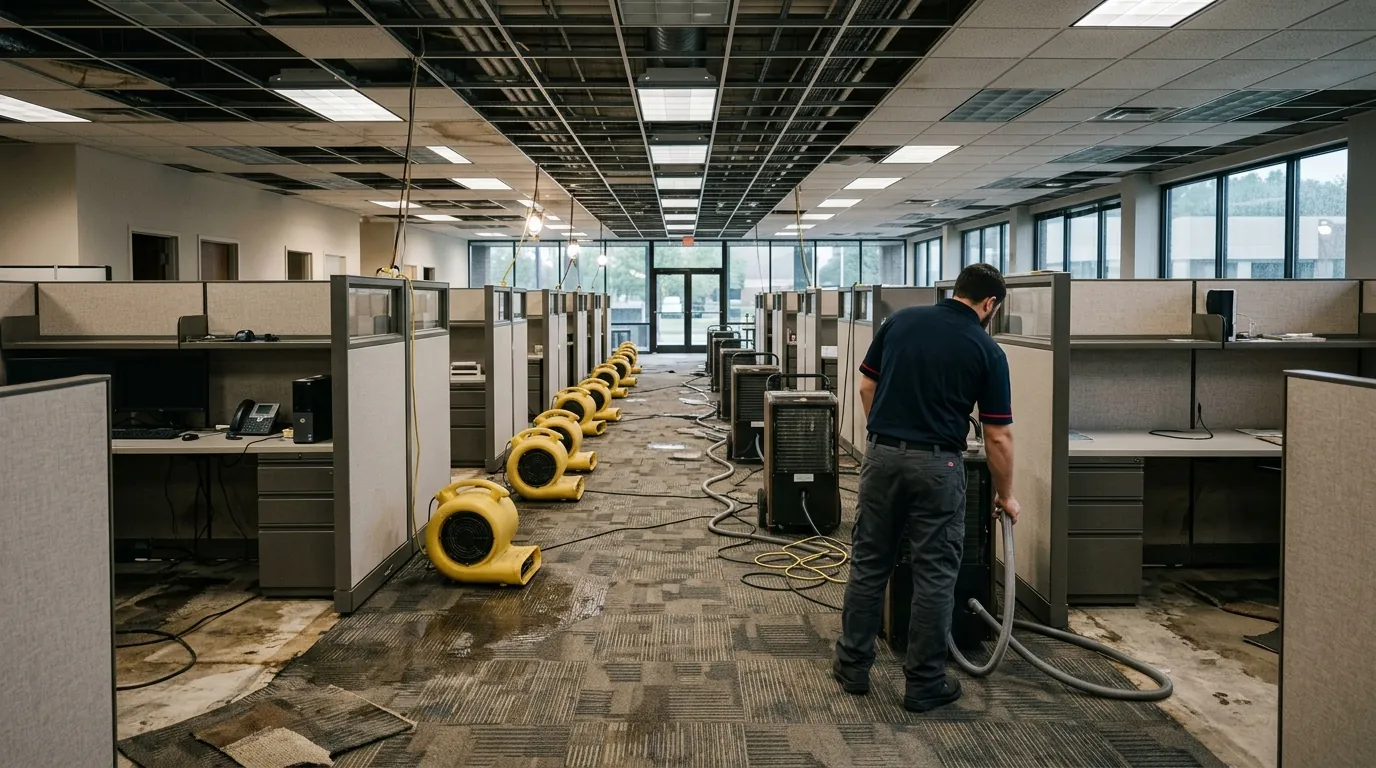
Commercial Restoration in Cranberry Township
24/7 commercial restoration in Cranberry Township and surrounding areas. Insurance billing accepted. Call (724) 452-7400.
A burst pipe at 2 a.m. in a commercial building hits differently than one in a house. You’re not just managing water — you’re managing payroll continuity, tenant liability, inventory loss, and a landlord or property manager who needs answers before the morning shift arrives. Commercial restoration is a different discipline from residential work: larger affected square footage, more complex mechanical systems, stricter documentation requirements for insurance carriers, and a hard business deadline driving every decision.
What commercial restoration actually involves
Commercial losses — whether from water, fire, or smoke — tend to compound quickly. A slow leak inside a drop-ceiling system can saturate insulation, corrode metal decking, and wick into drywall across hundreds of square feet before anyone notices a stain. A kitchen fire in a restaurant can push protein soot through the HVAC into every square foot of the dining room overnight. The scale and construction type of commercial buildings (steel framing, concrete block, suspended ceilings, shared mechanical shafts) mean moisture and contamination travel differently than they do in a wood-framed house.
The equipment required reflects that scale. Industrial-grade truck-mount extractors, large-format desiccant dehumidifiers, high-CFM axial air movers, and thermal imaging cameras to locate moisture behind finished surfaces are standard tools on a commercial job — not upgrades. Documentation runs parallel to the physical work: photo logs, moisture readings at defined grid points, and daily drying reports that give your insurance adjuster a defensible record of every decision made on-site.
Timeline depends on loss category and building construction, but most commercial water losses require 3–5 days of active structural drying before reconstruction can begin. Fire and smoke losses vary more widely — a contained electrical fire in a server room may clear in 48 hours; a full-floor office fire can run 2–4 weeks through soot removal, deodorization, and contents pack-out.
Our process
-
Emergency stabilization and loss containment. The first hours determine the final scope. We isolate the affected area from occupied or operational portions of the building, shut off contributing water or HVAC sources, and establish containment barriers where cross-contamination is a risk. For fire losses, this includes boarding openings and tarping the roof if the structure is compromised.
-
Damage assessment and documentation. Before extraction or demolition begins, we photograph and log every affected surface, document moisture readings with calibrated meters, and map the loss boundary. This baseline protects you if the adjuster disputes scope later — it’s the difference between a fully covered claim and an out-of-pocket argument.
-
Extraction, debris removal, and selective demolition. Standing water comes out first, then saturated materials that cannot be dried in place — wet insulation, compromised ceiling tile, Category 3-contaminated flooring. For fire losses, this step includes soot characterization: dry soot from wood and paper behaves differently than wet protein soot from a kitchen fire or synthetic soot from burning plastics, and each requires a different cleaning chemistry.
-
Structural drying or smoke and odor treatment. Water losses move into an engineered drying phase — dehumidifiers and air movers positioned to create a directed airflow pattern, with daily moisture readings to track progress toward target dry standards. Fire losses move into thermal fogging and, where needed, hydroxyl or ozone treatment to address odor molecules embedded in porous surfaces and HVAC components.
-
Clearance verification and reconstruction handoff. We don’t call a job complete based on visual inspection alone. Final moisture readings confirm structural materials have reached acceptable levels before we hand off to reconstruction. For mold-adjacent water losses, post-remediation verification protects the building owner from future liability. We coordinate directly with your insurance adjuster and, where needed, your general contractor to keep the rebuild timeline moving.
What separates a good commercial response from a bad one
The most common failure point in commercial restoration is scope creep caused by inadequate initial documentation. An adjuster who receives a vague estimate — “water damage to office area” — has every incentive to dispute line items later. Experienced operators document to the standard the carrier expects: per-room moisture logs, material identification, and a clear cause-and-origin narrative.
The second failure is treating a commercial building like a large house. Shared HVAC systems can distribute smoke or mold spores across tenant spaces that weren’t part of the original loss. Concrete and masonry dry on a completely different timeline than wood framing — running residential drying equipment on a concrete-block wall for three days accomplishes almost nothing. Equipment selection and drying calculations have to match the actual construction type.
Insurance adjusters on commercial losses also look specifically for containment documentation on Category 2 and Category 3 water losses. If a contractor extracted contaminated water but has no record of containment barriers or antimicrobial application, the carrier may require additional testing before approving reconstruction — adding days or weeks to your reopening timeline.
Seasonal and regional considerations
Cranberry Township and the broader Butler County area see significant freeze-thaw cycling from November through March. Sprinkler lines in unheated commercial spaces — parking garages, warehouse sections, storage areas — are a consistent source of large-volume water losses during cold snaps. Buildings constructed in the rapid commercial expansion along Route 228 and the PA Turnpike corridor often have long mechanical runs that are vulnerable to temperature swings when heating systems fail overnight. If your building has any unheated mechanical or storage space, a pre-winter inspection of pipe insulation is worth the hour it takes.
Service area
FireDEX Butler operates 24/7 out of Cranberry Township and handles commercial restoration across the surrounding region — including Mars, Zelienople, Wexford, Gibsonia, Butler, and communities throughout Butler and Allegheny counties. The city-specific pages linked from this section cover local response details for each area.
If you’re looking at water damage spreading across a commercial floor right now, or trying to understand what a smoke loss is going to cost your business, call (724) 452-7400. We’ll put eyes on the loss, give you an honest scope, and get the documentation started so your claim doesn’t stall.
Frequently Asked Questions
How does commercial water damage documentation differ from what's done on a residential claim?
Can you work around our business hours so we don't have to shut down completely?
What's the difference between Category 2 and Category 3 water in a commercial building, and why does it matter for the restoration scope?
How do you handle smoke and soot in a commercial HVAC system after a fire?
What should a property manager or business owner do in the first hour after discovering a commercial water loss?
Looking for the best commercial restoration company in Cranberry Township?
FireDEX Butler provides licensed and insured commercial restoration in Cranberry Township, PA and the surrounding area, and has served local property owners since 1981. We answer calls 24/7 — call (724) 452-7400 for immediate help.
Need Commercial Restoration now?
We respond 24/7 across Cranberry Township and surrounding PA cities.
Related Coverage
- Our Restoration Services
- Contact FireDEX Butler
- Commercial Restoration in Beaver Falls
- Commercial Restoration in Butler
- Commercial Restoration in Cranberry Township
- Commercial Restoration in Evans City
- Commercial Restoration in Gibsonia
- Commercial Restoration in Mars
- Commercial Restoration in Seven Fields
- Commercial Restoration in Wexford
- Commercial Restoration in Zelienople