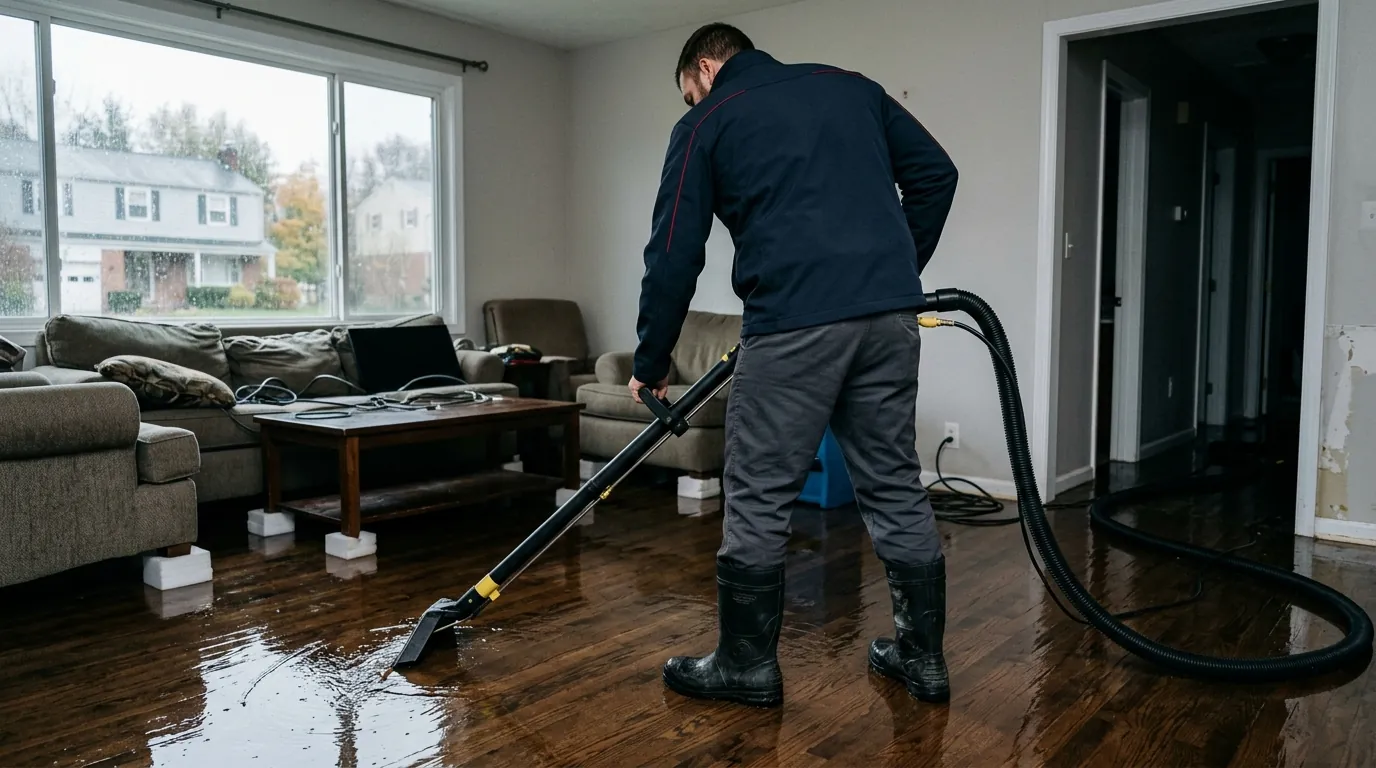
Flood Damage Restoration in Cranberry Township
24/7 flood damage restoration in Cranberry Township and surrounding areas. Insurance billing accepted. Call (724) 452-7400.
What happens in the first 24 hours matters more than most homeowners realize
Floodwater doesn’t just wet surfaces — it migrates. Within hours of a basement flooding or a storm surge pushing through a foundation wall, water wicks into drywall, travels along floor joists, and saturates insulation that will hold moisture for weeks if left alone. The visible puddle on the floor is rarely the whole story. What’s hiding inside wall cavities, beneath hardwood, and under slab-on-grade flooring is what determines whether a home dries out cleanly or develops a secondary mold problem that costs more to fix than the flood itself.
What flood damage restoration actually involves
Flood cleanup is not pumping out water and running a fan. A proper post-flood restoration starts with identifying the water category — groundwater and sewage-contaminated floodwater are Category 3 (grossly contaminated) and require a materially different response than a clean-water pipe burst. Category 3 water means affected porous materials like drywall, carpet, and insulation typically cannot be dried in place; they have to come out.
Once contaminated materials are removed, the structural drying phase begins. This involves industrial-grade truck-mount and portable extractors to pull standing water, followed by a calculated array of low-grain refrigerant (LGR) dehumidifiers and high-velocity air movers positioned to create a drying chamber around affected assemblies. Technicians use thermal hygrometers and penetrating moisture meters to establish a drying goal — a target moisture content based on unaffected reference materials in the same structure — and return daily to log readings and adjust equipment placement. Drying a flooded home typically takes three to five days under active equipment; structures with concrete block foundations or brick veneer common in older Western Pennsylvania housing stock can run longer.
For homes with finished basements — which describes a large share of the residential inventory in Cranberry Township and the surrounding townships — flood restoration also means evaluating whether the vapor barrier behind the drywall is intact, whether the sump system failed or was overwhelmed, and whether the HVAC system pulled contaminated air into the ductwork during the event.
Our process
-
Emergency water extraction and safety assessment. The moment we arrive, standing water comes out. We use truck-mount extractors for volume removal and follow with portable units to reach tight spaces — under stairs, inside wall cavities accessed through flood cuts, beneath floating floor systems. Simultaneously, we assess structural safety and identify electrical hazards before any equipment goes down.
-
Water category and contamination classification. We determine whether the source was clean water, gray water, or Category 3 floodwater. For storm flooding and sewer backups — both common in the Cranberry Township area during heavy rain events that overwhelm municipal storm infrastructure — we treat the loss as Category 3 by default until testing or source confirmation says otherwise. This classification drives every downstream decision about what materials stay and what goes.
-
Controlled demolition and materials removal. Contaminated drywall, insulation, carpet, and pad are removed to clean structural lines. We perform flood cuts at a consistent height above the waterline to expose wall cavities for drying, document all removed materials with photographs and itemized logs for your insurance adjuster, and bag and remove debris according to applicable disposal requirements.
-
Structural drying with daily moisture monitoring. LGR dehumidifiers and air movers are set to a calculated drying configuration — not just placed randomly. Each day, a technician returns to log moisture readings at every monitoring point, adjusts equipment as assemblies dry, and documents progress. We do not pull equipment until readings reach the established drying goal, not just until things feel dry to the touch.
-
Post-drying inspection and clearance documentation. Before reconstruction begins, we conduct a final moisture survey across all affected assemblies and provide a written drying report. This documentation is what your insurance carrier and any future buyer’s home inspector will want to see — it proves the structure was dried to standard, not just dried enough.
What separates a good flood response from a bad one
The most common mistake in residential flood cleanup is pulling equipment too early. A basement that reads dry at the surface can still carry elevated moisture in the bottom plate, the subfloor, or the concrete block wall behind the framing. Reconstruction over wet framing traps moisture and produces exactly the mold problem the remediation was supposed to prevent.
A second common failure is misclassifying the water source. Homeowners and less-experienced operators sometimes treat a storm flooding event as clean water because the basement “just filled up from the window well.” Groundwater that has traveled through soil, picked up lawn chemicals, and entered through a foundation crack is not clean water. Treating it as such means skipping the antimicrobial application and material removal steps that prevent microbial growth.
Insurance adjusters reviewing flood claims look for a moisture log with daily readings, a clear materials removal inventory with photographs, and a drying report that shows the structure reached goal. Claims that lack this documentation are harder to close and more likely to result in disputes over scope.
Seasonal and regional considerations
Western Pennsylvania’s wet springs and the frequency of heavy convective storms from June through September make basement flooding a recurring problem in the Pittsburgh suburbs. Cranberry Township’s mix of newer construction with sump-dependent drainage systems and older homes in adjacent communities with clay-heavy soils means both sump failures and foundation seepage are common flood sources. The region’s freeze-thaw cycles also create a secondary risk window in late winter, when ice damming and rapid snowmelt can push water through foundation walls and window wells that performed fine all summer.
Service area
FireDEX Butler is based in Cranberry Township and handles flood damage restoration throughout Butler County and the northern Pittsburgh suburbs — including Mars, Zelienople, Wexford, Harmony, Evans City, and surrounding communities. The city-specific pages for each area link back here for the full technical detail on our process.
If you’re standing in a flooded basement right now, call (724) 452-7400 — we respond 24/7. The sooner extraction starts, the shorter the drying timeline and the lower the risk of secondary damage. Request your flood damage assessment today.
Frequently Asked Questions
What is the difference between Category 2 and Category 3 floodwater, and why does it change what gets removed from my home?
How long does structural drying typically take after a basement flood?
My basement flooded from a storm — do I need to treat it differently than a pipe burst?
What documentation should I expect from a flood restoration company, and why does it matter for my insurance claim?
What should I do — and avoid — while waiting for the restoration crew to arrive after a flood?
Looking for the best flood damage restoration company in Cranberry Township?
FireDEX Butler provides licensed and insured flood damage restoration in Cranberry Township, PA and the surrounding area, and has served local property owners since 1981. We answer calls 24/7 — call (724) 452-7400 for immediate help.
Need Flood Damage Restoration now?
We respond 24/7 across Cranberry Township and surrounding PA cities.
Related Coverage
- Our Restoration Services
- Contact FireDEX Butler
- Flood Damage Restoration in Beaver Falls
- Flood Damage Restoration in Butler
- Flood Damage Restoration in Cranberry Township
- Flood Damage Restoration in Evans City
- Flood Damage Restoration in Gibsonia
- Flood Damage Restoration in Mars
- Flood Damage Restoration in Seven Fields
- Flood Damage Restoration in Wexford
- Flood Damage Restoration in Zelienople