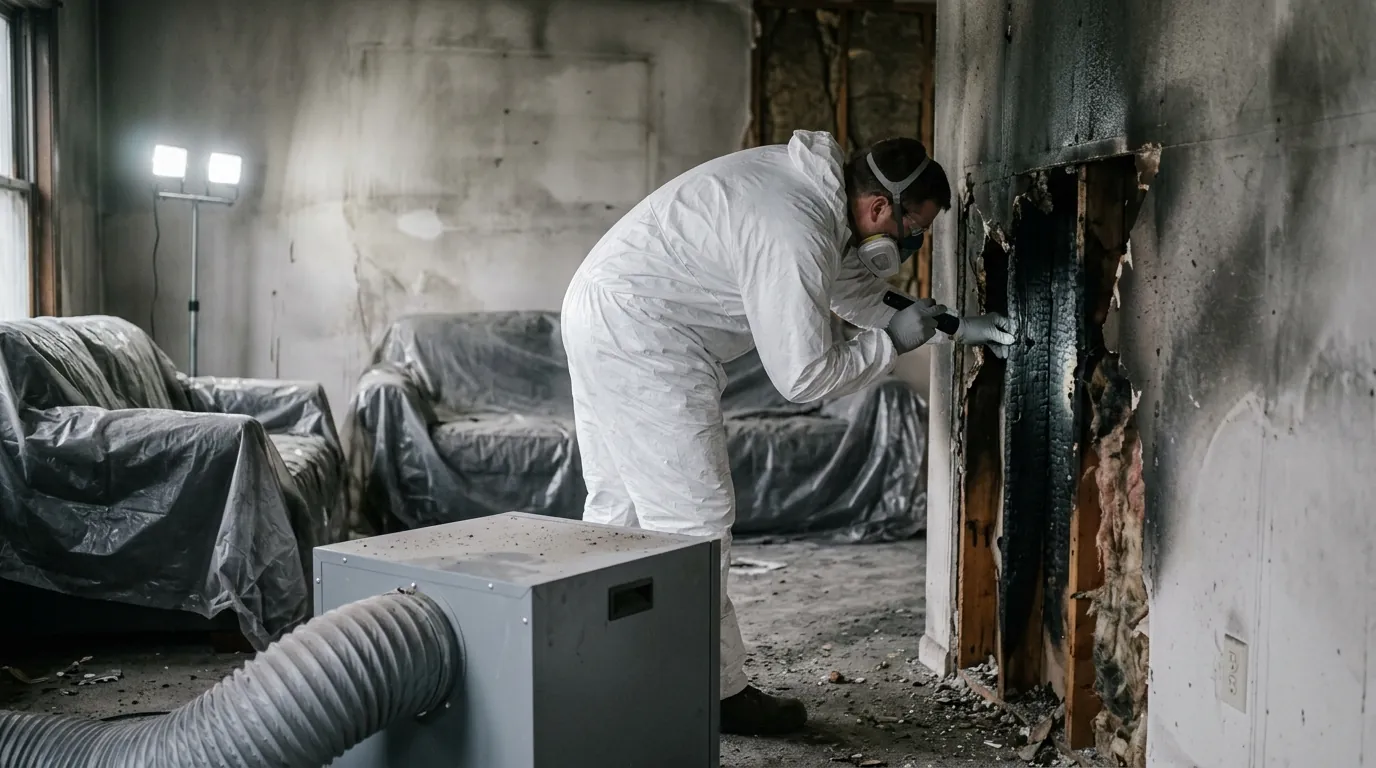
Fire Damage Restoration in Cranberry Township
24/7 fire damage restoration in Cranberry Township and surrounding areas. Insurance billing accepted. Call (724) 452-7400.
The fire is out, but the damage isn’t done. In the hours after a structural fire, soot particles continue to etch into surfaces, acidic smoke residue corrodes metal fixtures, and the smell of combustion works deeper into drywall, insulation, and HVAC ductwork. Every hour without professional intervention narrows the window for saving finishes, contents, and structural materials that would otherwise require full replacement.
What fire damage restoration actually involves
Fire cleanup is not a single task — it’s a sequenced technical process that addresses at least three distinct damage types simultaneously: thermal damage to structural components, soot and smoke residue on surfaces and in cavities, and water damage left behind by suppression efforts. A house fire that triggers a sprinkler system or requires significant hose work can leave behind thousands of gallons of water in addition to char and smoke penetration.
The work involves dry-ice blasting or chemical sponging of soot from framing and masonry, thermal fogging or ozone treatment to neutralize odor molecules embedded in porous materials, HEPA-filtered air scrubbing to capture airborne particulates, and a full contents pack-out when personal belongings need off-site cleaning and storage during structural repairs. Industrial dehumidifiers and air movers run in parallel to address suppression water before secondary mold growth can take hold — typically within 48 to 72 hours of saturation.
Timeline varies with fire size, construction type, and how quickly the response begins. A kitchen fire caught early may resolve in days. A fire that reaches the attic or travels through balloon-frame wall cavities — common in older Western Pennsylvania housing stock — can involve weeks of phased work.
Our process
-
Emergency stabilization and safety assessment. Before any cleaning begins, the structure is evaluated for compromised load-bearing elements, live utilities, and air quality hazards. Utilities are coordinated with local providers, and the building is secured against weather and unauthorized entry. Documentation — photographs, moisture readings, thermal imaging — starts here and feeds directly into the insurance claim.
-
Soot characterization and surface mapping. Not all soot is the same. Protein soot from kitchen fires is nearly invisible but leaves a powerful odor and a greasy film that bonds to painted surfaces. Synthetic soot from burning plastics, foam, or wiring insulation is oily, smears easily, and requires solvent-based cleaning agents rather than dry methods. Wet soot from a slow, smoldering fire is the most difficult to remove and penetrates deepest into porous substrates. Identifying the soot type before cleaning prevents the most common mistake in fire restoration: using the wrong method and permanently setting the residue.
-
Contents pack-out and structure preparation. Salvageable contents are inventoried, packed, and transported to a controlled cleaning facility. Unsalvageable materials — charred drywall, melted insulation, compromised flooring — are removed and properly disposed of. This step exposes hidden damage inside wall cavities and above ceilings that initial inspection cannot reach.
-
Odor neutralization. Surface cleaning removes visible residue but does not eliminate odor. Thermal fogging introduces a deodorizing agent in a vapor state that follows the same pathways smoke traveled — into wall cavities, HVAC ducts, and subfloor spaces. Ozone treatment may follow for persistent odor in enclosed areas. Both methods require the building to be vacated during treatment.
-
Structural drying, reconstruction scope, and clearance. Suppression water is extracted and the structure is dried to pre-loss moisture baselines. Once drying is confirmed and odor clearance is achieved, a detailed reconstruction scope is prepared for permitting and insurance approval. FireDEX Butler holds Pennsylvania contractor license #PA001913 and coordinates the full rebuild — framing, insulation, drywall, finishes — under one point of contact.
What separates a good fire damage response from a bad one
The most common failure point in fire and smoke restoration is treating it as a cleaning job rather than a building science problem. Crews that wipe surfaces without addressing the HVAC system leave smoke residue circulating through the home for months after work is complete. Contractors who skip thermal fogging because it adds a day to the timeline leave odor molecules embedded in wall cavities that no amount of repainting will cover.
Insurance adjusters look for documented soot mapping, moisture readings taken before and after drying, a line-item contents inventory, and photo documentation of every demolished material. Claims that lack this documentation frequently result in underpayment or disputes over what was actually damaged. The difference between a $40,000 approved claim and a $25,000 approved claim often comes down to the quality of the initial documentation — not the actual scope of damage.
Another common miss: smoke damage in the HVAC system. Ductwork acts as a distribution network for combustion particles. A fire in one room can deposit residue throughout every room served by the same air handler. Restoration that doesn’t include duct inspection and cleaning leaves the homeowner with recurring odor complaints long after the visible damage is repaired.
Seasonal and regional considerations
Western Pennsylvania winters create specific complications for post-fire response. A fire that compromises exterior walls or the roof in January exposes the interior to freezing temperatures, which can burst supply lines, damage remaining contents, and complicate the drying process. Emergency board-up and temporary heat must be established quickly. Cranberry Township and the surrounding Butler County area also see a spike in chimney and heating-equipment fires each fall as wood-burning appliances are put back into service after summer — often without inspection. These fires frequently involve creosote, which produces a particularly dense, oily soot that requires specialized cleaning chemistry.
Service area
FireDEX Butler serves Cranberry Township and the broader region including Butler, Mars, Wexford, Zelienople, Evans City, and surrounding communities throughout Butler and northern Allegheny counties. The city-specific pages for each area link back here for the full technical detail on how fire and smoke restoration works.
If you’re standing in a smoke-damaged home right now, the clock is already running. Call (724) 452-7400 — we respond 24/7 — and begin soot and smoke removal before permanent etching and odor set in.
Frequently Asked Questions
What's the difference between protein soot and synthetic soot, and why does it change how you clean?
My house smells like smoke even in rooms that weren't near the fire — why?
How does the contents pack-out process work, and will my belongings be safe?
What should I do — and not do — while waiting for the restoration crew to arrive?
How do you document fire damage for an insurance claim, and what does an adjuster actually need?
Looking for the best fire damage restoration company in Cranberry Township?
FireDEX Butler provides licensed and insured fire damage restoration in Cranberry Township, PA and the surrounding area, and has served local property owners since 1981. We answer calls 24/7 — call (724) 452-7400 for immediate help.
Need Fire Damage Restoration now?
We respond 24/7 across Cranberry Township and surrounding PA cities.
Related Coverage
- Our Restoration Services
- Contact FireDEX Butler
- Fire Damage Restoration in Beaver Falls
- Fire Damage Restoration in Butler
- Fire Damage Restoration in Cranberry Township
- Fire Damage Restoration in Evans City
- Fire Damage Restoration in Gibsonia
- Fire Damage Restoration in Mars
- Fire Damage Restoration in Seven Fields
- Fire Damage Restoration in Wexford
- Fire Damage Restoration in Zelienople
- How To Choose a Restoration Company in (Without Getting Burned)
- The Fire Damage Restoration Process, Explained
- How Professionals Remove Smoke Odor (and Why DIY Usually Fails)