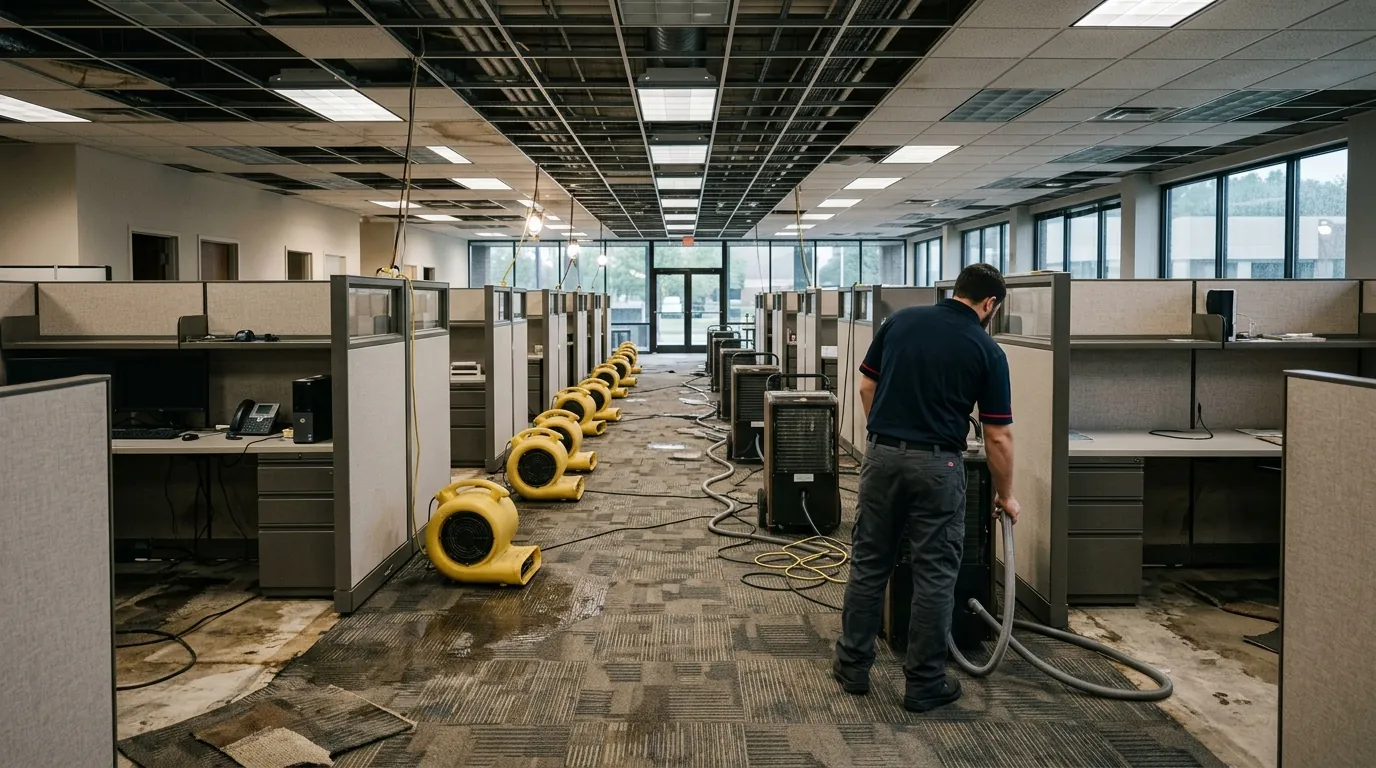
Commercial Restoration in Cranberry Township
24/7 commercial restoration in Cranberry Township, PA. Insurance billing accepted. Call (724) 452-7400.
Our technicians are headquartered right here in Cranberry Township and are typically on-site within 60 minutes of your call.
Along the Route 19 / Route 228 corridor, commercial properties face a particular kind of vulnerability: rapid growth has packed office parks, retail strips, and medical-adjacent businesses into a corridor that sits squarely in Butler County’s freeze-thaw zone, and when a sprinkler line bursts at 2 a.m. or a kitchen suppression system discharges in a Cranberry Commons restaurant, the clock on business interruption starts immediately. FireDEX Butler is headquartered right here in Cranberry Township — on Marshall Road — so the same crew that answers your call can be pulling hose before a Pittsburgh-based competitor has even mapped the route.
Why Cranberry Township Commercial Properties Face Distinct Restoration Challenges
Cranberry Township’s explosive growth from a rural crossroads into Butler County’s most populous municipality (~33,000 residents) means the commercial building stock spans five decades of construction standards in a tight geography. Retail and office buildings along Route 19 built in the 1980s and 1990s carry aging HVAC and plumbing infrastructure that is now reaching end-of-life, while newer mixed-use developments near the I-79 / Pennsylvania Turnpike interchange were built fast to meet demand, sometimes with compressed inspection timelines.
The soil is the other variable most out-of-area contractors underestimate. Cranberry Township sits on heavy clay, which holds water instead of draining it. After a hard spring thaw or a summer cloudburst that overwhelms the Brush Creek drainage system, hydrostatic pressure builds against foundation walls of strip malls, professional office buildings, and flex-industrial spaces alike. That pressure doesn’t announce itself — it seeps through block mortar joints, saturates concrete slab edges, and wicks into finished flooring before a building manager notices the smell. By the time standing water is visible, Category 2 or Category 3 contamination may already be present.
Fire losses in commercial settings here often involve the same suppression systems designed to limit damage. A discharged dry-pipe or wet-pipe sprinkler system in a professional building near Cranberry Commons can release hundreds of gallons across server rooms, reception areas, and storage — creating a combined fire-and-water loss that requires coordinated structural drying, smoke odor neutralization, and contents handling simultaneously.
Our Commercial Restoration Process in Cranberry Township
Every commercial loss in the 16066 ZIP code gets a dedicated project manager on-site within the first hour of mobilization — not a call-center intake rep, but someone who can authorize equipment deployment, photograph conditions for your insurance adjuster, and walk your facilities manager through what happens next.
The process moves in four phases calibrated to commercial timelines:
Immediate stabilization — water extraction, emergency board-up or tarping, and containment barriers to protect undamaged inventory or equipment. For multi-tenant buildings, containment also means protecting neighboring tenants from cross-contamination.
Structural assessment and drying — commercial concrete slabs and steel-stud framing dry differently than residential wood-frame construction. We use industrial desiccant dehumidifiers and high-velocity air movers sized for commercial square footage, not residential units running at capacity. Moisture mapping is documented daily so your adjuster has a defensible drying log.
Smoke and odor remediation — in fire losses, thermal fogging and hydroxyl generation address smoke penetration in ductwork and above drop ceilings, which is where odor resurfaces weeks after a claim closes if it is not addressed at the source.
Reconstruction and code compliance — FireDEX Butler holds Pennsylvania Home Improvement Contractor Registration (#PA001913) and performs structural rebuild so you are not managing a handoff between a mitigation company and a separate GC. For commercial properties, that single point of accountability shortens the return-to-occupancy timeline measurably.
Reaching Cranberry Township Commercial Sites
Because our shop is on Marshall Road, we are already inside the township when a call comes in — not staging from Pittsburgh or New Castle. The Route 19 corridor, the office parks near Graham Park, and the retail density around Cranberry Commons are all within a short drive. For properties near the I-79 / Pennsylvania Turnpike interchange, we can approach from either the northern or southern ramp depending on traffic, which matters when a loss happens during the morning commute window on a weekday. We operate 24 hours a day, seven days a week, so there is no after-hours surcharge or delayed mobilization for overnight events.
Local Note
One pattern we see repeatedly in Cranberry Township commercial buildings that were constructed during the 1990s growth surge: the mechanical rooms and utility chases were often built tight to meet the footprint of the lot, and insulation was sometimes omitted or compressed around supply lines where they pass through exterior walls. In a January polar snap — the kind that drops Butler County into the single digits for three or four consecutive nights — those uninsulated chase sections are the first to freeze and the first to burst. The loss typically presents as a ceiling collapse in a first-floor office or retail space, not as a visible pipe failure, because the break is inside the wall cavity above the drop ceiling. If your building went up between 1988 and 2002 and has not had a mechanical audit, that is worth knowing before the next hard freeze.
If your Cranberry Township commercial property has been affected by water, fire, or storm damage — or if you want a pre-loss walkthrough before the next weather event — call FireDEX Butler at (724) 452-7400. We are local, we are available around the clock, and we know this township’s building stock from the inside out.
Commercial Restoration in Cranberry Township: Service Coverage
Frequently Asked Questions
How fast can you arrive for commercial restoration in Cranberry Township?
How quickly can FireDEX Butler reach a commercial property along the Route 19 corridor in Cranberry Township?
Cranberry Township's clay soil causes basement and slab seepage in commercial buildings — does that affect how you dry a structure after a water loss?
Are commercial properties near Cranberry Commons or the I-79 interchange treated differently for insurance documentation than smaller office buildings?
What makes commercial fire restoration in Cranberry Township different from a standard residential fire job?
Do 1990s-era commercial buildings in Cranberry Township have specific vulnerabilities that affect restoration timelines?
Commercial Restoration response in Cranberry Township
Most Cranberry Township calls see a technician on-site within 60 minutes from our Cranberry Township headquarters.