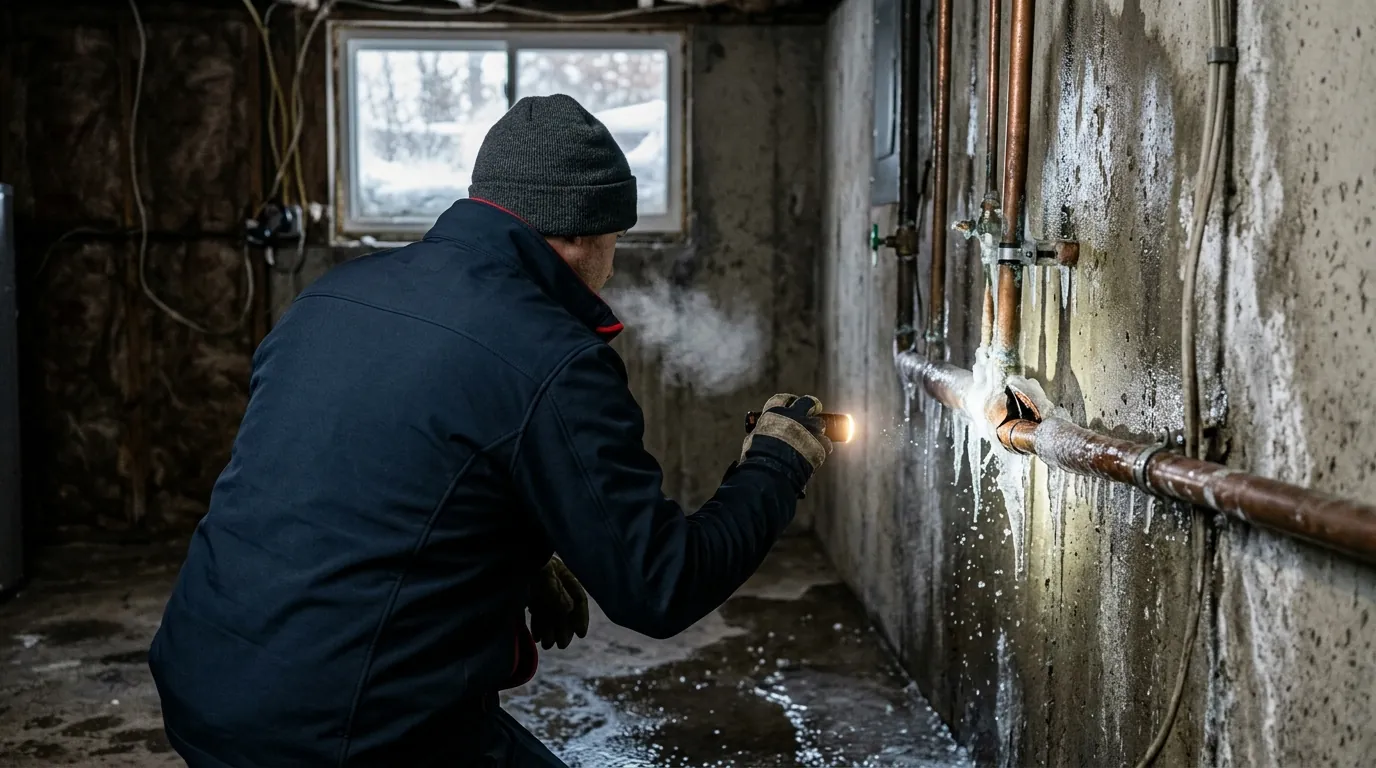
Frozen Pipe Restoration in Cranberry Township
24/7 frozen pipe restoration in Cranberry Township, PA. Insurance billing accepted. Call (724) 452-7400.
Our technicians are headquartered right here in Cranberry Township and are typically on-site within 60 minutes of your call.
January polar snaps hit Cranberry Township hard — and when Arctic air funnels down the I-79 corridor and overnight lows drop into the single digits, the supply lines running through exterior walls and unheated crawl spaces of homes across Fox Run and Fernway freeze fast. When those pipes thaw, they don’t just drip — they release gallons into finished basements, drywall cavities, and hardwood floors before most homeowners realize anything has happened. FireDEX Butler operates out of Cranberry Township itself, which means when your pipe lets go at 2 a.m., the crew responding isn’t driving in from Pittsburgh.
Why Cranberry Township Homes Are Particularly Vulnerable to Frozen Pipe Damage
Cranberry Township’s growth from a rural crossroads to Butler County’s fastest-growing municipality (~33,000 residents) happened in waves, and each wave left a different plumbing fingerprint. The older Fernway plats — many laid out in the 1960s — still carry galvanized steel supply lines that are nearing or past the end of their service life. Galvanized pipe corrodes from the inside out, narrowing the interior diameter over decades, and that restriction makes these lines freeze faster and burst more violently than modern copper or PEX when temperatures plunge. A single cold night can turn a marginal pipe into a full-bore failure.
The 1990s-through-2020s construction that fills neighborhoods like Fox Run, Park Place, and Ehrman Farms brought a different set of risks. Two-story colonial and craftsman plans in these developments often route supply lines through exterior wall cavities on the north and west faces of the home — the sides that take the brunt of wind chill when Arctic air pushes through. When insulation is thin or improperly installed behind those walls, the pipe freezes, thaws, and the water drops straight onto a finished lower level: LVP flooring, drywall, insulation batt, and framing all absorbing moisture simultaneously.
Nearly every home in the 16066 ZIP code has a basement, and a large share of those basements are finished living space. That matters because a burst pipe on the first floor doesn’t just damage the floor — it saturates the ceiling assembly of the finished basement below, and that assembly is often a combination of drywall, drop tile, and spray foam that traps moisture and creates ideal conditions for mold colonization within 48 to 72 hours if not dried aggressively.
Our Frozen Pipe Restoration Process in Cranberry Township
Restoring a frozen-pipe loss isn’t just about extracting standing water — it’s about finding all the water, including the water you can’t see. The process begins with a full moisture survey using thermal imaging cameras and non-penetrating moisture meters. In Cranberry Township’s newer two-story homes, we pay particular attention to the wall cavity between the exterior sheathing and the interior drywall, where water can travel several feet from the actual pipe failure before appearing as a stain or wet spot.
Once the scope is mapped, extraction equipment removes standing water from hard surfaces and carpet. Structural drying follows immediately — high-capacity dehumidifiers and directional air movers are positioned to dry wall cavities, subfloor assemblies, and ceiling systems from the inside out. In finished basements, this often means removing baseboard trim and drilling small evaporation ports into the bottom of drywall panels to allow airflow behind the wall surface without a full tear-out. We monitor moisture readings daily and adjust equipment placement until readings return to pre-loss baselines.
If the pipe failure involved older galvanized supply lines, we document the condition of the surrounding plumbing and flag it for your plumber — not to upsell anything, but because a second failure in an adjacent section is common and worth knowing about before you put new drywall over it.
Reaching Cranberry Township Neighborhoods Around the Clock
FireDEX Butler’s shop sits on Marshall Road, which puts us inside Cranberry Township before we even hit a traffic light. For homes near Cranberry Commons or along the Route 19 / Route 228 corridor, we’re typically on-site faster than a crew dispatched from the Pittsburgh metro. For neighborhoods deeper in the township — Glen Eden, Cranberry Heights, or properties near the Cranberry Township Community Park — the drive is still measured in single-digit minutes rather than the 30-plus-minute response times common from firms based south of the Turnpike interchange.
Because we operate 24/7, a pipe that lets go on a Sunday morning or during a weeknight ice event gets the same crew and the same equipment as a weekday call. Water damage doesn’t pause for business hours, and neither do we.
Local Note
One pattern we see repeatedly in Cranberry Township’s older Fernway-area homes: the galvanized supply line running to an exterior hose bib on the north wall often shares a wall cavity with the kitchen or laundry supply lines. When that hose-bib line freezes and bursts, homeowners assume the damage is limited to the exterior wall — but water frequently migrates laterally inside the wall cavity and surfaces 8 to 12 feet away, sometimes in a cabinet or behind a finished wall in an adjacent room. If you’ve had a freeze event and see a water stain somewhere that doesn’t make obvious sense, that lateral migration is often the explanation. We scope the full cavity before any drywall goes back up.
If you’re dealing with a burst or thawing pipe anywhere in Cranberry Township, call FireDEX Butler at (724) 452-7400. We’ll assess the full extent of the damage, get drying equipment in place the same day, and document everything your insurance carrier needs to process the claim.
Frozen Pipe Restoration in Cranberry Township: Service Coverage
Frequently Asked Questions
How fast can you arrive for frozen pipe restoration in Cranberry Township?
How quickly can FireDEX Butler reach a frozen pipe emergency in the Fox Run or Ehrman Farms neighborhoods?
Are the older homes in Cranberry Township's Fernway neighborhood at higher risk for frozen pipe damage than newer construction?
My finished basement in the 16066 ZIP code flooded after a pipe burst upstairs — how do you dry a ceiling/floor assembly like that without tearing everything out?
Will my homeowner's insurance cover frozen pipe restoration in Cranberry Township, and what documentation do you provide?
How long does frozen pipe water damage restoration typically take for a two-story home in Cranberry Township?
Frozen Pipe Restoration response in Cranberry Township
Most Cranberry Township calls see a technician on-site within 60 minutes from our Cranberry Township headquarters.