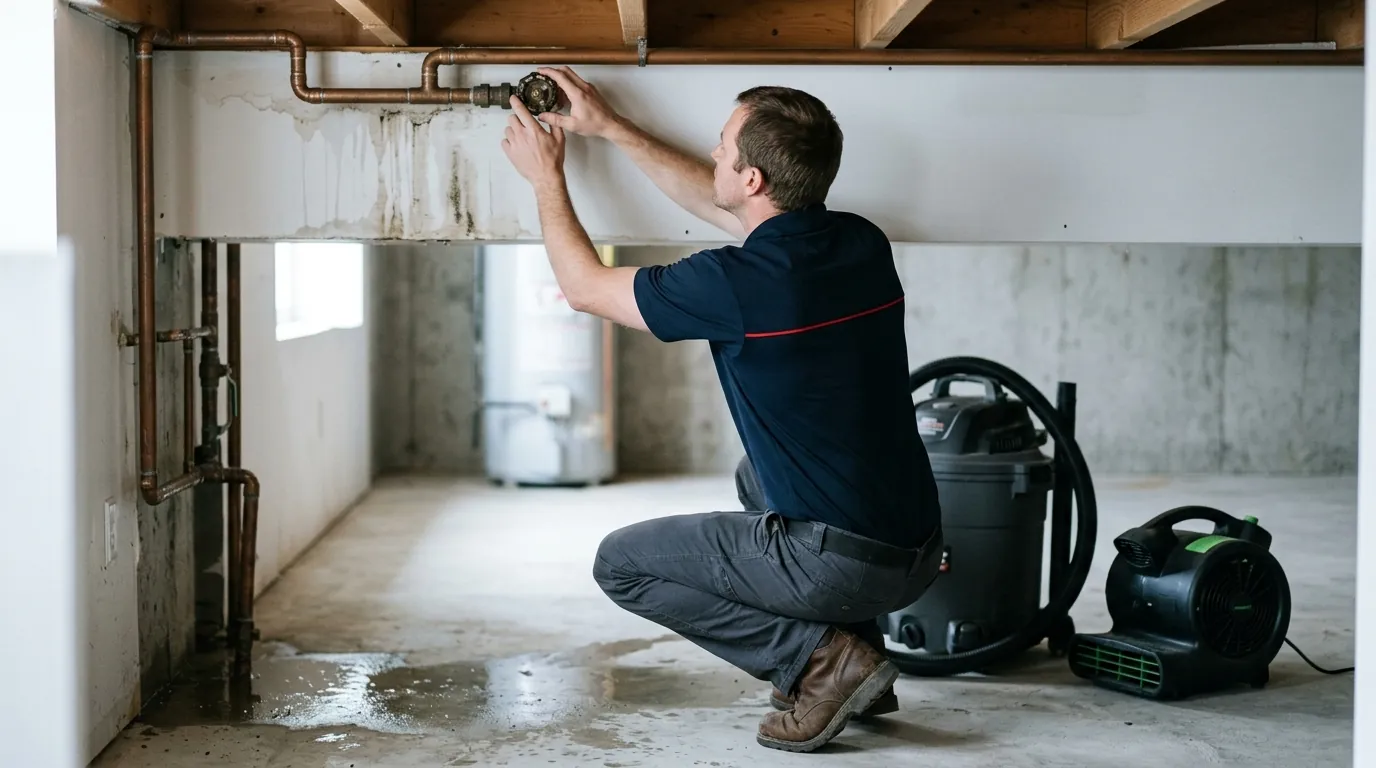
Burst Pipe Cleanup and Repair in Cranberry Township
24/7 burst pipe cleanup and repair in Cranberry Township and surrounding areas. Insurance billing accepted. Call (724) 452-7400.
A pipe doesn’t announce itself before it bursts. One morning you walk into the basement and your feet are wet. Or you come home after a weekend away to find the ceiling in the hallway has collapsed under the weight of standing water. Within the first hour, water from a broken supply line or failed copper fitting can travel through wall cavities, saturate subfloor sheathing, and begin wicking into framing lumber — damage that a shop vac and a few box fans won’t undo. The window to prevent secondary mold growth and structural deterioration is measured in days, not weeks.
What burst pipe cleanup and repair actually involves
The visible water is only part of the problem. When a water line breaks under pressure, water follows the path of least resistance — through insulation, behind drywall, under hardwood flooring, into the air gap beneath a concrete slab. A thorough response means locating all of it, not just the puddles you can see.
Professional burst pipe cleanup combines plumbing coordination (stopping the source), water extraction, and structural drying into a single managed process. The extraction phase uses truck-mounted or portable extraction units capable of pulling hundreds of gallons from flooring and carpet in a single pass. Once standing water is removed, the drying phase begins: industrial-grade desiccant or refrigerant dehumidifiers, high-velocity air movers positioned to create a calculated airflow pattern across wet assemblies, and in some cases specialty drying mats placed directly on hardwood floors to draw moisture upward without requiring board removal.
The timeline for structural drying depends on the materials involved and how long the water sat before extraction began. Drywall and insulation that has been wet for more than 48–72 hours typically cannot be dried in place and must be removed. Engineered hardwood responds differently than solid wood. Concrete slabs can hold moisture for weeks. A moisture mapping protocol — using thermal imaging cameras and calibrated pin and pinless meters — tells the crew exactly where drying equipment needs to be repositioned each day and when the structure has returned to acceptable moisture levels.
Our process
-
Emergency water shutoff and source assessment. Before any cleanup begins, the water source must be confirmed as stopped. We coordinate with your plumber or, when needed, can assist in identifying the shutoff. We then assess the category of water involved — clean supply-line water (Category 1) behaves very differently from a failed drain line or toilet supply (Category 2), and that classification drives every decision about what materials can be saved versus removed.
-
Moisture mapping and scope documentation. Using thermal imaging and calibrated moisture meters, we map the full extent of water migration — not just the obvious wet zones. This documentation becomes the foundation of your insurance claim and prevents disputes later about what was actually affected.
-
Extraction and controlled demolition. Standing water is extracted first. Then, any materials that cannot be dried in place — saturated insulation, compromised drywall, buckled flooring — are removed to expose the wet structural assembly beneath. We cut flood cuts at the appropriate height to allow airflow behind wall cavities rather than trapping moisture inside.
-
Structural drying with daily monitoring. Drying equipment is deployed in a calculated configuration based on the affected square footage and material types. We return daily to take moisture readings, reposition equipment as drying progresses, and document each visit. Drying is not complete until readings return to pre-loss baselines — not just until things “feel dry.”
-
Antimicrobial treatment and clearance. Once structural drying is confirmed, affected surfaces receive an EPA-registered antimicrobial application to inhibit mold colonization before reconstruction begins. Final moisture readings are logged and provided to you and your insurance carrier.
What separates a good burst pipe response from a bad one
The most common mistake is stopping at extraction. A crew that pumps out the water and sets a few fans has addressed maybe 30% of the actual damage. The moisture that has migrated into wall cavities, under flooring, and into framing continues to move and evaporate into the air — raising indoor humidity and feeding mold growth — unless drying equipment is sized correctly and monitored daily.
A second failure point is misclassifying the water source. A supply line break is Category 1 — clean water. But if that water sat for more than 24–48 hours, or contacted sewage, soil, or certain building materials, it degrades to Category 2 or 3 and requires a more aggressive removal protocol. Treating Category 2 water as Category 1 is a documentation and health risk that insurance adjusters and industrial hygienists will flag.
Insurance adjusters look for daily moisture logs, thermal imaging reports, and a clear chain of documentation showing when readings were taken, what equipment was deployed, and when the structure reached dry standard. Without that paper trail, claims get delayed or reduced.
Seasonal and regional considerations
Western Pennsylvania’s freeze-thaw cycle is one of the most reliable predictors of burst pipe calls. Cranberry Township and the surrounding Butler County communities sit in a climate band where overnight temperatures can drop into the single digits in January and February while afternoon temperatures climb above freezing — a pattern that stresses supply lines in uninsulated exterior walls, crawlspaces, and garages. Pipes in older homes in communities like Zelienople, Mars, and Evans City that were built before modern insulation standards are particularly vulnerable.
The risk doesn’t end when temperatures rise. A pipe that partially froze and cracked in January may not fail visibly until a warm spell in March increases water pressure. Spring thaw is consistently a second peak season for burst pipe calls in this region.
Service area
FireDEX Butler is based in Cranberry Township and responds to burst pipe cleanup and repair calls throughout Butler County and the surrounding region, including Mars, Zelienople, Evans City, Wexford, and communities across the North Hills. The location-specific pages for each city link back here for full service detail.
If you’re standing in water right now, call (724) 452-7400 — we respond 24/7 (license #PA001913). The sooner extraction and drying equipment is on-site, the more of your structure and contents can be saved.
Frequently Asked Questions
How long does structural drying take after a burst pipe, and what affects that timeline?
Does the category of water from a burst pipe affect what materials can be saved?
What should I do — and not do — while waiting for the cleanup crew to arrive?
Why do flood cuts get made at a specific height, and does that height matter for my insurance claim?
How does thermal imaging help after a pipe burst, and is it part of a standard response?
Looking for the best burst pipe cleanup and repair company in Cranberry Township?
FireDEX Butler provides licensed and insured burst pipe cleanup and repair in Cranberry Township, PA and the surrounding area, and has served local property owners since 1981. We answer calls 24/7 — call (724) 452-7400 for immediate help.
Need Burst Pipe Cleanup and Repair now?
We respond 24/7 across Cranberry Township and surrounding PA cities.
Related Coverage
- Our Restoration Services
- Contact FireDEX Butler
- Burst Pipe Cleanup and Repair in Beaver Falls
- Burst Pipe Cleanup and Repair in Butler
- Burst Pipe Cleanup and Repair in Cranberry Township
- Burst Pipe Cleanup and Repair in Evans City
- Burst Pipe Cleanup and Repair in Gibsonia
- Burst Pipe Cleanup and Repair in Mars
- Burst Pipe Cleanup and Repair in Seven Fields
- Burst Pipe Cleanup and Repair in Wexford
- Burst Pipe Cleanup and Repair in Zelienople