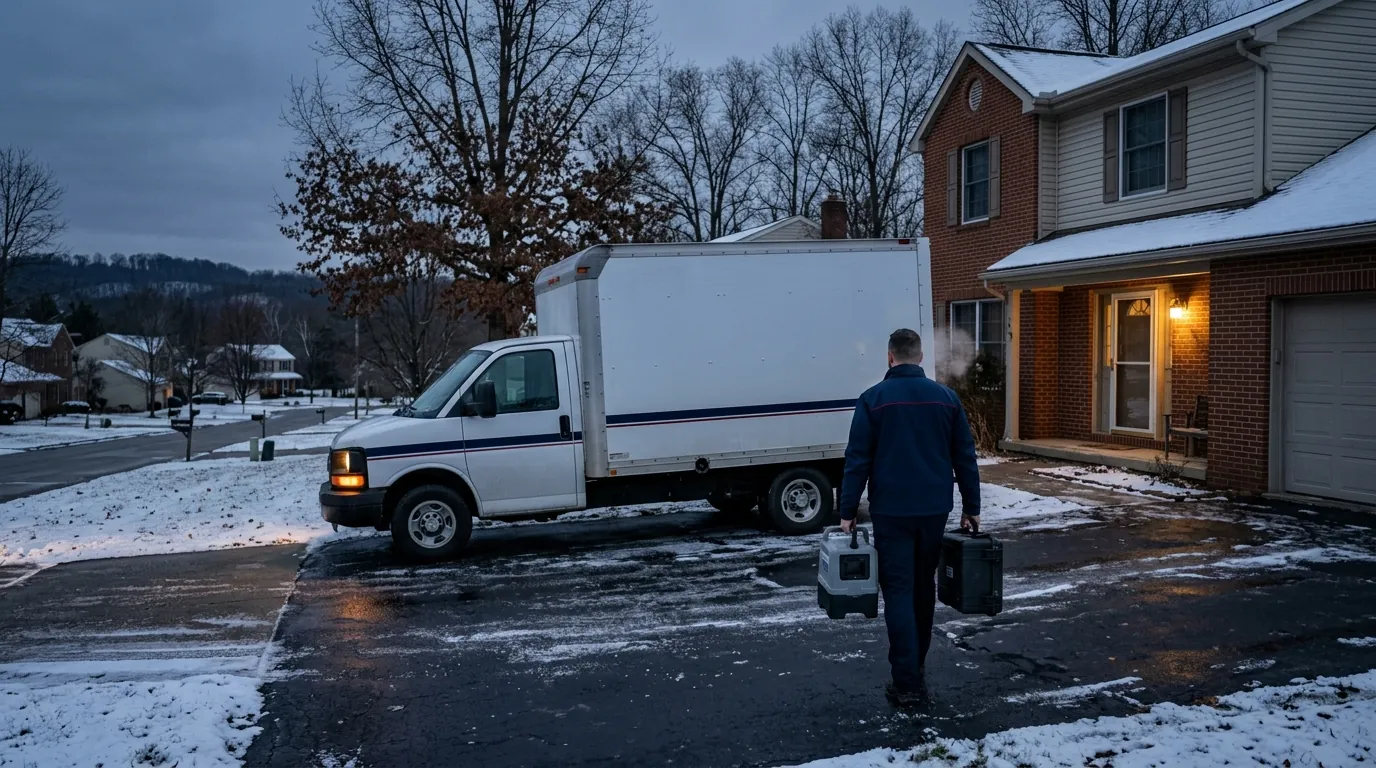
Mold doesn’t always announce itself with a black wall or a flooded basement. More often it grows quietly inside a wall cavity, under a bathroom subfloor, or behind a kitchen cabinet — invisible until the damage is already significant. If you’ve noticed a musty smell, an unexplained cough, or a water stain that came and went, you may already be living with hidden mold. Here are seven specific signs to look for, what each one means, and the steps to take before the problem gets worse.
The 7 Signs — What to Look For and Where
1. A persistent musty or earthy smell with no obvious source. Mold produces microbial volatile organic compounds (mVOCs) as it metabolizes organic material. That damp-basement, old-book odor — especially in a room that doesn’t have a basement — is often the first clue. If it’s stronger in one corner, near a vent, or when the HVAC kicks on, follow it. The smell intensifying after rain is particularly telling.
2. Water stains that appeared, dried, and reappeared. A stain that comes back after you’ve wiped it down isn’t just cosmetic. Recurring discoloration on a ceiling, around a window frame, or along a baseboard usually means there’s an ongoing moisture source — a slow pipe drip, a flashing failure, or condensation — feeding mold growth behind the surface.
3. Warped, bubbling, or soft drywall or flooring. Drywall that feels spongy when you press it, laminate flooring that’s buckling at the seams, or hardwood that’s cupping along the grain — all of these point to moisture that has been sitting long enough to compromise the material. Mold colonizes cellulose-based materials (drywall paper, wood subfloor, OSB sheathing) within 24 to 72 hours of sustained wetness.
4. Unexplained allergy-like symptoms that improve when you leave the house. Runny nose, itchy eyes, a scratchy throat, or a cough that clears up on weekends or vacations — and returns when you’re home — can signal airborne mold spores. This isn’t a diagnosis, and mold isn’t the only possible cause, but the pattern is worth paying attention to. If multiple household members notice it, take it seriously.
5. Visible dark spots in unusual places. Not every dark spot is mold, but spots that appear on grout lines, around window sills, along the base of exterior walls, or on the back side of furniture pushed against an outside wall deserve a closer look. Black, green, gray, or even white fuzzy growth in these locations is a flag — especially if it reappears after cleaning with a household cleaner.
6. A recent leak, flood, or plumbing repair that wasn’t dried out professionally. If a pipe burst, an appliance overflowed, or a roof leak soaked your attic insulation in the last year or two — and drying was handled with fans and towels rather than professional equipment — there’s a real chance mold took hold where you couldn’t see it. Moisture meters and thermal imaging can detect residual wetness that looks dry to the eye.
7. Rust or mineral staining on pipes or inside cabinets under sinks. Slow drips leave evidence. Rust rings on a P-trap, white mineral deposits on supply lines, or a cabinet floor that feels slightly soft are all signs of chronic low-level moisture. The cabinet’s interior — dark, enclosed, rarely opened — is exactly the kind of environment mold prefers.
Immediate Steps When You Suspect Hidden Mold
Don’t start tearing into walls yet. Here’s a methodical approach:
- Identify and stop the moisture source first. Mold remediation is pointless if the leak or condensation problem is still active. Check under sinks, around the toilet base, along the roofline, and at any penetrations (pipes, vents, windows). If you find an active drip, shut off the supply to that fixture or the main shutoff if needed.
- Document what you see and smell. Take photos of stains, warping, or visible growth with something in frame for scale. Note where the smell is strongest and at what times of day. This documentation helps both a remediation professional and your insurance adjuster.
- Improve ventilation without spreading spores. Open windows in the affected room if outdoor humidity is lower than indoor humidity. Do NOT run a box fan blowing air from a mold-suspect area into the rest of the house — that distributes spores.
- Avoid disturbing visible mold. Scrubbing a mold spot without containment releases a concentrated burst of spores into the air. Leave it alone until you know the scope of the problem.
- Test if you need confirmation. DIY mold test kits (petri dish style) can confirm presence but won’t tell you the species, concentration, or extent. A professional air quality test or surface sample analyzed by a certified lab gives you actionable data.
What NOT to Do
- Don’t paint or caulk over it. Encapsulating mold without removing it doesn’t solve the problem — it delays it, and the mold continues to degrade the substrate underneath.
- Don’t assume bleach solves it. Bleach kills surface mold on non-porous materials like tile. On drywall or wood, the water in bleach penetrates and the chlorine doesn’t — you may kill the surface while feeding the deeper growth.
- Don’t ignore it because it’s small. A 2-inch spot on the outside of drywall can be a 2-square-foot colony on the back side. What you can see is rarely the full picture.
- Don’t run your HVAC without checking the filter. If mold has been present for a while, spores may have been pulled into the return air. A clogged or contaminated filter recirculates the problem.
When to Call a Professional
Some mold situations are genuinely DIY-manageable — a small spot of surface mold on a bathroom tile, for example. But call a professional remediation company when:
- The visible mold covers more than 10 square feet (roughly a 3×3 area), which is the EPA’s general threshold for professional involvement.
- The mold is on or near HVAC components, ductwork, or air handlers.
- You’ve had a major water intrusion event — a burst pipe, a sewage backup, a roof collapse — and the drying wasn’t handled with commercial dehumidifiers and moisture monitoring.
- Anyone in the household has a compromised immune system, asthma, or a known mold sensitivity.
- You’ve cleaned it twice and it keeps coming back.
- You can smell it but can’t find it.
In the Cranberry Township area, older homes — particularly those built before the 1980s — often have less vapor barrier protection and are more susceptible to moisture intrusion through crawl spaces and basement walls. If your home fits that profile and you’re seeing any of the signs above, a professional assessment is worth the call.
The Remediation Process — What to Expect
If an assessment confirms mold, professional remediation typically follows this sequence:
- Containment — Plastic sheeting and negative air pressure keep spores from migrating to clean areas during work.
- Removal — Affected porous materials (drywall, insulation, subfloor sections) are removed and bagged. Non-porous surfaces are HEPA-vacuumed and treated with an EPA-registered antimicrobial.
- Drying — Commercial dehumidifiers and air movers bring structural moisture levels down to acceptable readings before any rebuild begins.
- Clearance testing — A post-remediation air sample or surface test confirms spore counts are back to normal background levels.
- Reconstruction — Once clearance is achieved, new drywall, insulation, and flooring go back in.
The timeline depends on scope. A single wall cavity might be resolved in a day or two. A crawl space or attic with widespread growth can take a week or more.
If you’ve worked through this list and you’re still not sure what you’re dealing with — or you’ve found something that clearly needs more than a sponge and a bottle of cleaner — the right move is to get a professional set of eyes on it before the scope grows. FireDEX Butler handles mold remediation in Cranberry Township and the surrounding area. You can reach the team at (724) 452-7400 to schedule an assessment.