Flood Damage Restoration in Beaver Falls
24/7 flood damage restoration in Beaver Falls, PA. Insurance billing accepted. Call (724) 452-7400.
Our technicians are dispatched from our Cranberry Township, PA headquarters and are typically on-site in Beaver Falls within 60 minutes of your call.
When the Beaver River backs up after a heavy rain or a cast-iron drain gives out in one of College Hill’s century-old frame houses, the water moves fast and the damage compounds quickly. Beaver Falls sits in a river valley where humidity stays high well into autumn, stone and block foundations wick groundwater even in dry spells, and the housing stock along the numbered avenues was built long before modern moisture barriers existed. Flood damage here is not just a wet-floor problem — it is a race against swelling subfloors, saturated plaster, and the mold clock that starts ticking within 24 to 48 hours of standing water.
Why Beaver Falls Properties See Flood Damage Issues
The geography and building history of Beaver Falls create a specific set of flood vulnerabilities that show up on loss reports again and again. The river-valley terrain channels stormwater toward low-lying neighborhoods, and properties near the Beaver River corridor can see yard and basement flooding during moderate rain events — not just named storms. Basements in the older rowhomes and detached frame houses on College Hill and along the avenues typically have stone or poured-block foundations with no waterproof coating, so hydrostatic pressure pushes groundwater through wall joints long after the rain stops.
Inside those homes, the original plumbing tells its own story. Galvanized supply lines corrode from the inside out, narrowing over decades until a cold snap or a pressure spike causes a failure. Cast-iron drain stacks crack at the hub joints and can back up raw sewage into lower-level floors — a category 3 contamination event that requires a different response than clean-water flooding. Aging furnaces and the space heaters that supplement them add burst-pipe risk every January and February when temperatures drop overnight. Along the Seventh Avenue business district, older commercial buildings carry flat or low-slope roofs that pond water and eventually leak through failed membrane seams, creating ceiling and wall saturation that affects both the structure and any occupied tenant space below.
Our Flood Damage Restoration Process in Beaver Falls
Every flood job starts with a thorough assessment before any equipment is placed. The water source matters enormously: a clean supply-line break is handled differently from a sewage backup or a roof-leak intrusion that has been slow-feeding a wall cavity for weeks. We document moisture readings across affected materials — concrete, plaster, wood framing, insulation — using thermal imaging and calibrated moisture meters, then map a drying plan specific to what we find.
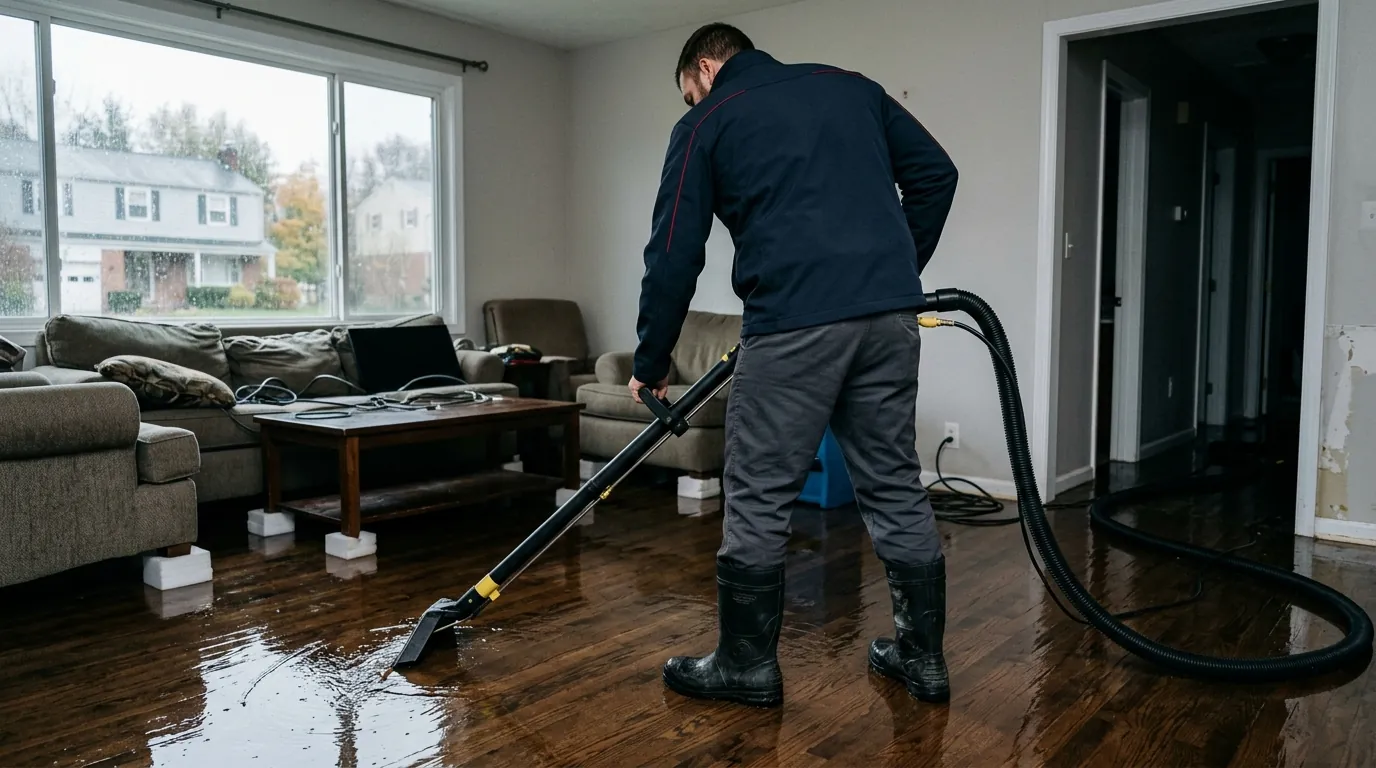
Extraction comes first. Truck-mounted and portable extractors pull standing water from floors, crawlspaces, and carpeted areas. In Beaver Falls homes with original hardwood floors over board subfloors, we use targeted drying systems that introduce warm, dry air beneath the surface rather than simply blasting the room — this reduces the chance of cupping and warping that would otherwise require full floor replacement. Structural drying with commercial-grade dehumidifiers and air movers runs continuously, with moisture readings logged daily so we can demonstrate progress and adjust equipment placement as the numbers move.
When sewage is involved, affected materials are treated as contaminated: porous items that cannot be disinfected to a safe standard are removed, bagged, and disposed of properly. Hard surfaces are cleaned with EPA-registered disinfectants before drying begins. We do not skip this step to save time.
Reaching Beaver Falls from Cranberry Township
FireDEX Butler operates around the clock from Cranberry Township, and Beaver Falls is a straightforward run — Route 68 to I-76 west puts a crew at most addresses in the 15010 ZIP code in roughly 25 minutes under normal conditions. For properties near the Route 18 corridor or Patterson Township, routing is direct and does not require navigating through downtown. We answer calls at any hour, so if a pipe lets go at 2 a.m. in a College Hill rental or a sump pump fails during a weekend storm, you are not waiting until morning to start the conversation.
Local Note: What Plaster Walls Mean for Drying Time
One thing that catches homeowners off guard in Beaver Falls’s pre-war housing stock is how differently plaster behaves compared to modern drywall. Gypsum drywall releases absorbed moisture relatively quickly once the air around it is dry; original lime-and-sand plaster over wood lath holds water in the matrix and releases it slowly, sometimes over two to three times as long. A room that looks dry to the eye can still be reading elevated moisture deep in the wall assembly. We account for this in our drying timelines and do not call a job complete until meter readings across all materials — including plaster walls — have returned to acceptable baselines. Pulling equipment too early in a plaster-wall home is one of the most common reasons secondary mold problems develop weeks after the initial flood event.
Insurance Coordination for Beaver Falls Flood Claims
Standard homeowners policies in Pennsylvania typically cover sudden and accidental water losses — a burst pipe, an appliance failure, a roof leak from a storm — but exclude rising groundwater and surface flooding unless a separate flood policy (usually through the NFIP) is in place. This distinction matters a great deal in Beaver Falls, where the same rain event can cause both a sump-pump overflow (often covered) and river-related yard flooding (often not covered under standard HO policies).
We document losses thoroughly from the first hour on-site: photographs, moisture maps, material inventories, and written scope. That documentation goes directly to your adjuster and is formatted to match what carriers expect, which shortens the back-and-forth and reduces the chance of a scope dispute mid-job. We bill carriers directly for covered losses and walk you through what your policy does and does not cover before work begins — no surprises on the back end.
If you are dealing with flood damage at a property in Beaver Falls, call FireDEX Butler at (724) 452-7400. We are available around the clock, and the sooner extraction and drying begin, the more of the structure — and your budget — we can save.
Flood Damage Restoration in Beaver Falls: Service Coverage
Frequently Asked Questions
How fast can you arrive for flood damage restoration in Beaver Falls?
How quickly can FireDEX Butler reach a flood emergency in the College Hill or Downtown Beaver Falls area?
Are the older homes along Beaver Falls's numbered avenues more at risk for sewage backup flooding?
Does Beaver Falls's river-valley location affect whether a flood loss is covered by standard homeowners insurance?
Why does drying take longer in Beaver Falls's older plaster-wall homes compared to newer construction?
What should a Beaver Falls homeowner do in the first hour after discovering flood damage?
Flood Damage Restoration response in Beaver Falls
Most Beaver Falls calls see a technician on-site within 60 minutes from our Cranberry Township headquarters.