Flood Damage Restoration in Butler
24/7 flood damage restoration in Butler, PA. Insurance billing accepted. Call (724) 452-7400.
Our technicians are dispatched from our Cranberry Township, PA headquarters and are typically on-site in Butler within 60 minutes of your call.
When Connoquenessing Creek backs up during a heavy rain event, the low-lying streets near Downtown Butler can go from damp to ankle-deep in under an hour. That kind of flooding — fast, murky, and loaded with sediment — hits Butler’s older housing stock especially hard. Brick foursquares and frame homes built before 1950 absorb standing water through foundation walls, subfloor joists, and original plaster in ways that newer construction simply doesn’t. FireDEX Butler has been responding to exactly these situations since 1981, and our crew knows the difference between a manageable cleanup and a loss that compounds by the hour.
Why Butler Properties See Flood Damage Differently
Butler County’s topography works against homeowners when the rain comes hard. The creek and its tributary runs drain steep hillsides quickly, pushing water toward lower elevations — including streets and basements in Lyndora and East Butler where the grade flattens out. Once that water finds a foundation crack or an aging window well, it moves fast.
The housing stock makes the problem worse. Most homes in Butler were built before modern moisture barriers, vapor retarders, and pressure-treated lumber became standard. Original cast-iron drain stacks corrode from the inside out, and galvanized supply lines develop pinhole leaks that go unnoticed until a finished basement is already soaked. Fuse-era electrical panels — still common in Institute Hill and Lyndora — create a real safety concern the moment floodwater reaches the utility room. That’s why the first thing our team does on arrival is assess electrical safety before any extraction equipment goes in.
Commercial properties along the Main Street business district and near Butler Memorial Hospital face a different version of the problem: flat or low-slope roofs that pond water, aging floor drains that back up under surcharge, and occupied spaces that can’t simply be shut down for a week of drying.
Our Flood Damage Restoration Process in Butler
Every flood job starts with a thorough moisture mapping of the structure — not just the visibly wet areas. Water migrates. It travels under hardwood, wicks up plaster, and pools inside wall cavities before you can see it on the surface. We use thermal imaging and calibrated moisture meters to trace where it went, then build a drying plan around what we find rather than what’s obvious.
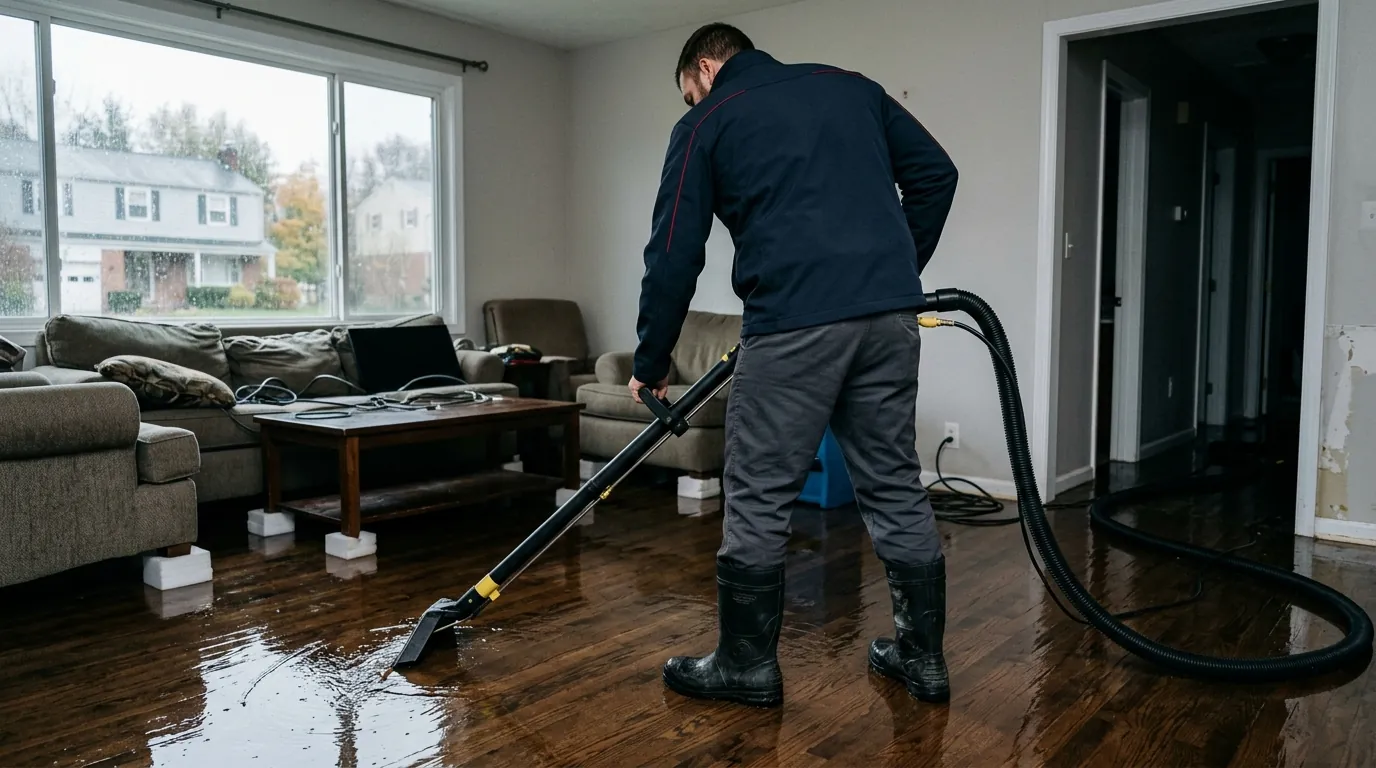
Extraction comes first: truck-mounted and portable units pull standing water from basements, crawlspaces, and finished living areas. Structural drying follows — commercial-grade desiccant and refrigerant dehumidifiers, high-velocity air movers positioned to create the airflow patterns that actually move moisture out of materials rather than just across their surface. We monitor readings daily and adjust equipment placement until every affected assembly reaches its dry standard.
In Butler’s pre-1950 homes, plaster walls require a different approach than modern drywall. Plaster releases moisture slowly — sometimes taking 40 to 60 percent longer to reach acceptable readings than drywall under identical conditions. We account for that in the drying timeline so nothing gets closed up prematurely.
When sewage or creek water is involved, contamination protocols apply. Category 3 water — the kind that comes in from outside during a flood event — requires removal of saturated porous materials that can’t be adequately sanitized, followed by antimicrobial treatment of the structural shell before any rebuild begins.
Reaching Butler from Cranberry Township
FireDEX Butler operates around the clock, every day of the year. Our base in Cranberry Township puts us on Route 228 or I-79 north to Butler in typical conditions, with crews able to reach most ZIP codes in the 16001 and 16002 areas without the routing delays that affect contractors coming from Pittsburgh. Steep hillside streets — the kind common near Institute Hill — don’t slow us down the way they slow unfamiliar crews, particularly in winter when those grades ice up before the main roads do.
For commercial losses near the hospital corridor or Downtown Butler, we can stage multiple units simultaneously and coordinate with building management to minimize disruption to occupied areas.
Butler Insurance Coordination
Flood losses in Butler often involve a combination of homeowner’s policy coverage and, where applicable, separate flood insurance through the National Flood Insurance Program. We document the loss thoroughly — photographs, moisture readings, material inventories, and scope of work — in the format adjusters need to process claims efficiently. We bill carriers directly and work with your adjuster from initial estimate through final sign-off, so you’re not managing paperwork while also managing a wet basement. As a Pennsylvania Home Improvement Contractor (Registration #PA001913), our documentation meets the standards Pennsylvania insurers require for residential claims.
Local Note
Homes in Lyndora and East Butler that sit within a few blocks of creek drainage areas often have what locals call “wet basements” that owners have managed for decades with sump pumps and floor drains. After a significant flood event, that history matters: repeated moisture cycles over 50 or 70 years leave behind elevated baseline humidity in the framing, residual efflorescence on foundation walls, and sometimes latent mold in areas that were never fully dried after past events. When we scope a flood job in these neighborhoods, we look at the whole picture — not just what the current event did, but what the structure has been dealing with for years. That context changes both the drying protocol and what we recommend for long-term prevention.
If your home or business in Butler has taken on water — whether from a backed-up drain, a creek-driven event, or a burst pipe in a finished basement — call FireDEX Butler at (724) 452-7400. We’re available around the clock, and we’ll tell you honestly what you’re dealing with from the moment we walk in the door.
Flood Damage Restoration in Butler: Service Coverage
Frequently Asked Questions
How fast can you arrive for flood damage restoration in Butler?
Are homes near Connoquenessing Creek at higher risk for recurring flood damage?
How does Butler's pre-1950 housing stock affect the flood restoration timeline?
Does flood water from a creek or storm drain count differently for insurance purposes than a burst pipe?
Can you handle flood damage in occupied commercial buildings near the Downtown Butler or hospital corridor?
What happens if floodwater reached the electrical panel or utility room in my Butler home?
Flood Damage Restoration response in Butler
Most Butler calls see a technician on-site within 60 minutes from our Cranberry Township headquarters.