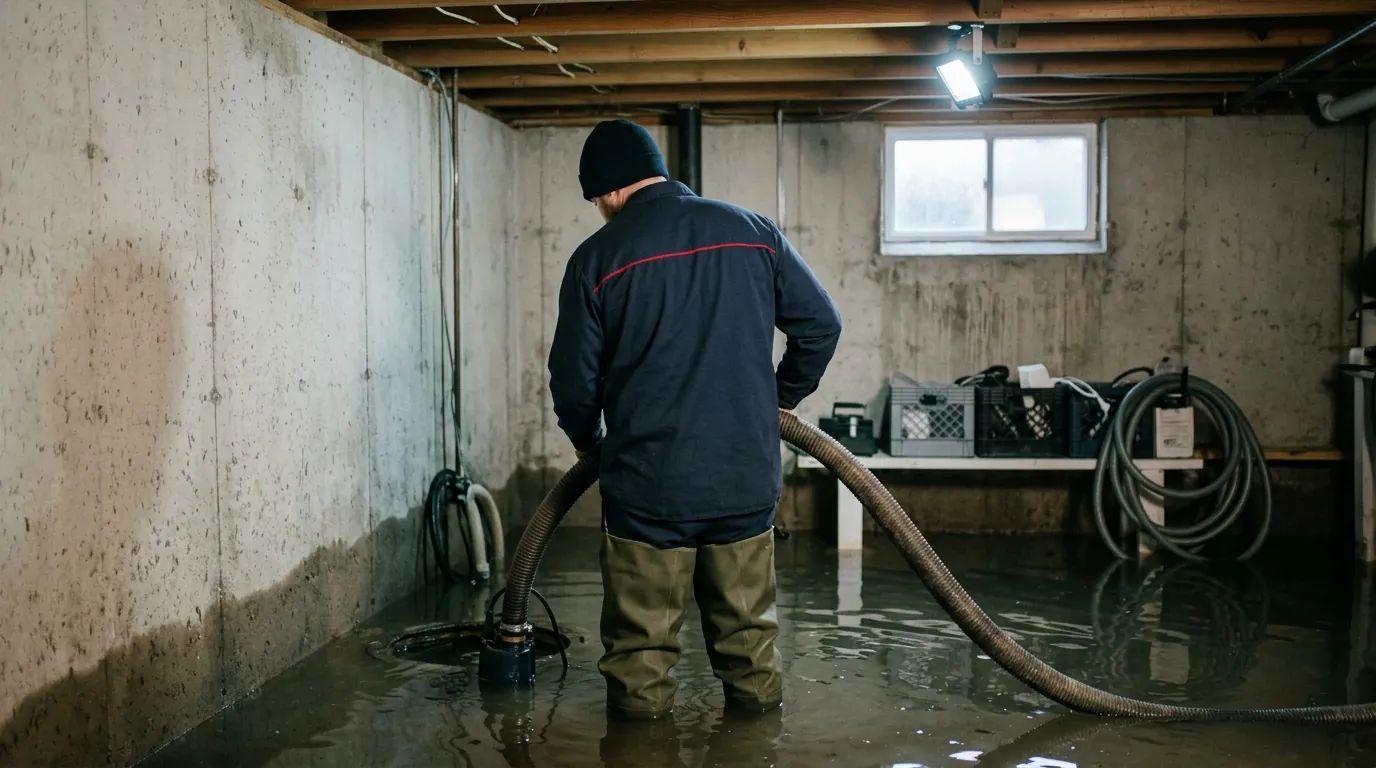
Basement Flooding Cleanup in Cranberry Township
24/7 basement flooding cleanup in Cranberry Township, PA. Insurance billing accepted. Call (724) 452-7400.
Our technicians are headquartered right here in Cranberry Township and are typically on-site within 60 minutes of your call.
Spring in Cranberry Township arrives with a one-two punch: snowmelt saturating Butler County’s dense clay soil and the first heavy thunderstorms rolling up the I-79 corridor. When that combination overwhelms a sump pump — or when a January polar snap bursts a supply line in an older Fernway ranch — finished basement floors can be underwater in under an hour. FireDEX Butler operates out of Cranberry Township itself, so when you call (724) 452-7400, a crew is loading equipment on Marshall Rd while most competitors are still mapping the route.
Why Cranberry Township Basements Flood the Way They Do
The township’s explosive growth — from quiet farmland to Butler County’s largest municipality, now topping 33,000 residents — compressed decades of different construction eras into a few square miles. The 1960s plats in Fernway still carry original galvanized supply lines that are well past their service life; when those pipes finally let go in a cold snap, they can dump hundreds of gallons into a finished lower level before anyone notices a pressure drop. Newer two-story builds from the 1990s through 2020s — common along the Route 19 and Route 228 corridor — face a different set of risks: washing-machine supply hoses, water heaters tucked into utility closets, and second-floor bathrooms whose failures soak through floor assemblies into the level below.
Then there is the soil. Heavy clay throughout the township resists drainage, and during a wet April or May the hydrostatic pressure against foundation walls can push seepage through hairline cracks faster than a dehumidifier can keep up. Brush Creek and its tributaries back up during cloudburst storms, compounding the problem for properties in lower-lying sections. Understanding which failure mode you are dealing with — sump overflow, pipe burst, hydrostatic seepage, or appliance leak — changes how the drying plan is written from the first hour on-site.
Our Basement Flooding Cleanup Process in Cranberry Township
Every job starts with moisture mapping, not guessing. Technicians use thermal imaging and calibrated moisture meters to trace exactly how far water has migrated into wall cavities, under flooring, and into structural framing — critical in finished basements where water travels silently behind drywall before it becomes visible. From there the process moves through four stages:
1. Water extraction. Truck-mounted and portable extractors pull standing water from carpet, pad, and hard flooring. In basements with luxury vinyl plank or glued-down tile — common in Fox Run and Park Place builds from the 2000s — we assess whether the floor can be saved before deciding on removal versus aggressive drying in place.
2. Controlled demolition when needed. Wet drywall below the flood line, saturated insulation, and soaked carpet padding are removed. Saving these materials is not worth the mold risk; in Butler County’s humid summers, colonization can begin within 24 to 48 hours of a moisture event.
3. Structural drying. Industrial air movers and desiccant or refrigerant dehumidifiers run in a calculated configuration based on the cubic footage and material types in the space. Readings are logged at each visit so drying progress is documented — useful for insurance adjusters and for confirming the space is genuinely dry, not just surface-dry.
4. Clearance and restoration scope. Once moisture readings reach target levels, we provide a written drying report and coordinate with your adjuster on the rebuild scope — framing, insulation, drywall, flooring, and paint.
Insurance Coordination for Cranberry Township Homeowners
Most standard homeowner policies in Pennsylvania cover sudden and accidental water damage — a burst pipe or an appliance failure — but exclude gradual seepage and flood events. That distinction matters when you are filing a claim after a Brush Creek backup versus a washing-machine hose failure, and adjusters will ask for documentation to support the cause of loss. FireDEX Butler photographs the source, the migration path, and the affected materials before anything is moved or removed, creating the evidence trail that supports your claim. We bill major carriers directly and work with your adjuster throughout the process so you are not managing paperwork while also managing a wet basement.
If the loss is not covered — or if you are paying out of pocket — we walk through the scope line by line before work begins. No surprises on the invoice.
Local Note
One pattern that comes up repeatedly in Cranberry Township’s 1990s and early-2000s finished basements: the vapor barrier behind the drywall was often installed incorrectly — placed on the warm side of the insulation rather than the cold side — which means that during a seepage event, moisture gets trapped between the barrier and the concrete wall and has nowhere to go. By the time water appears at the baseboard, the cavity behind it has been wet for days. On jobs in neighborhoods like Glen Eden and Ehrman Farms, we probe the wall assembly before assuming a simple extraction and dry-out will be sufficient; that extra step has caught hidden saturation that would have become a mold problem within a week.
If your basement in the 16066 ZIP code took on water — whether from a sump failure last night or seepage you noticed this morning — call (724) 452-7400. FireDEX Butler responds around the clock, and Cranberry Township is our home territory.
Basement Flooding Cleanup in Cranberry Township: Service Coverage
Frequently Asked Questions
How fast can you arrive for basement flooding cleanup in Cranberry Township?
How quickly can FireDEX Butler reach a flooded basement in the Fox Run or Park Place area?
Are older Fernway homes at higher risk for serious basement water damage compared to newer builds in Cranberry Township?
My basement flooded after a heavy storm and I think it came through the foundation wall — will my homeowner's insurance cover that in Pennsylvania?
How long does basement drying typically take in Cranberry Township's climate, and what affects that timeline?
Does Cranberry Township's heavy clay soil affect how basement flooding cleanup is handled compared to areas with sandier ground?
Basement Flooding Cleanup response in Cranberry Township
Most Cranberry Township calls see a technician on-site within 60 minutes from our Cranberry Township headquarters.