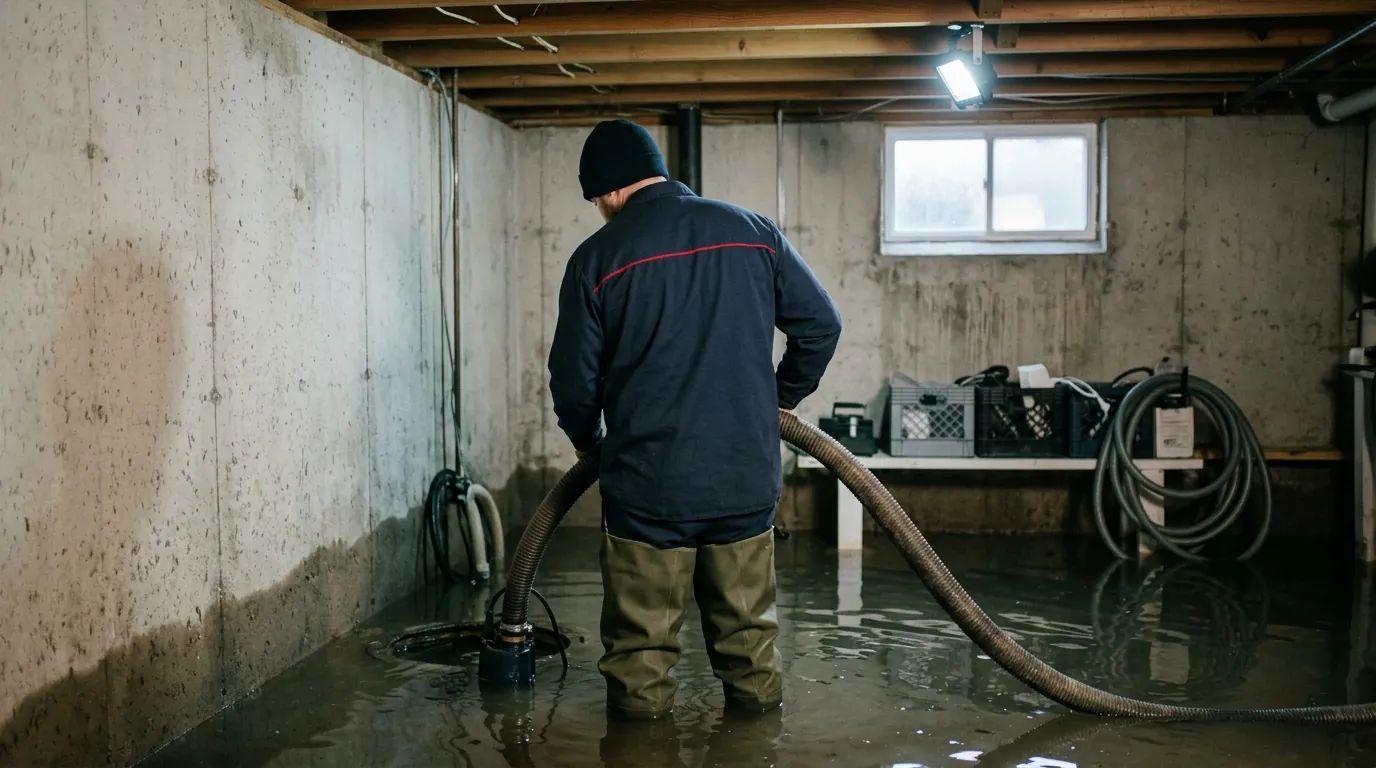
Basement Flooding Cleanup in Cranberry Township
24/7 basement flooding cleanup in Cranberry Township and surrounding areas. Insurance billing accepted. Call (724) 452-7400.
What happens in the first 24 hours matters more than most homeowners realize
You walk downstairs and your feet are wet before you reach the bottom step. Standing water in a basement isn’t just inconvenient — it’s a clock. Mold can begin colonizing porous materials like drywall, insulation, and wood framing within 24 to 48 hours of saturation. The water you can see is rarely the whole problem; it’s the water wicked into concrete block walls, trapped under a slab, or absorbed into the bottom plates of finished walls that causes the long-term structural damage and air quality issues that show up months later.
What basement flooding cleanup actually involves
Basement flooding cleanup is a different animal than a burst pipe on the first floor. Basements present specific challenges: limited airflow, below-grade concrete that holds moisture for weeks, sump pits that may have backed up with Category 2 or Category 3 water (gray water or sewage-contaminated water), and finished spaces where water hides behind drywall and under laminate flooring long after the visible puddles are gone.
The work starts with water classification. Clean water from a failed supply line is handled differently than water that backed up through a floor drain or sump basin — the latter carries bacteria and requires more aggressive cleaning protocols and disposal procedures. Once the water source is identified and stopped, high-capacity truck-mounted or portable extractors pull standing water from the floor. Depending on the depth and square footage, extraction alone can take one to several hours.
After extraction, the real drying work begins. Industrial-grade dehumidifiers — not the box-store units that move a few pints a day — are positioned to pull moisture from the air and from building materials. High-velocity air movers are placed to create a drying vortex across walls, floors, and ceilings. Moisture readings are taken at multiple points using penetrating and non-penetrating meters to map the full extent of saturation, including inside wall cavities and below flooring. Drying typically runs three to five days, with daily monitoring to confirm the structure is trending toward dry standard.
Our process
-
Water classification and source control — Before any equipment goes in, the water source is identified and confirmed stopped. A floor drain backup, a failed sump pump, and a foundation seepage problem each require a different response. The water category (clean, gray, or black) determines how the space is handled from that point forward.
-
Extraction — Standing water is removed using truck-mounted or portable extractors. Submersible pumps handle deeper flooding; weighted extraction tools pull water from carpet and padding. No drying equipment runs efficiently while standing water remains.
-
Moisture mapping and material assessment — Thermal imaging cameras and calibrated moisture meters document saturation levels in concrete, framing, drywall, and subfloor. This step produces the baseline readings that drive the drying plan and support your insurance claim documentation.
-
Structural drying with daily monitoring — Dehumidifiers and air movers run continuously. Moisture readings are logged each day to verify drying progress. If a wall cavity or subfloor assembly isn’t responding, targeted drying techniques — including drilling small access holes to direct airflow — are used before demolition becomes necessary.
-
Antimicrobial treatment and clearance — Once materials reach dry standard, affected surfaces are treated with EPA-registered antimicrobial agents to inhibit mold growth. Final moisture readings are documented and provided to you and your adjuster as proof of completion.
What separates a good basement flooding response from a bad one
The most common mistake is stopping at visible water. A shop vac and a few fans will dry the surface while leaving concrete block walls, bottom plates, and subfloor assemblies saturated for weeks. That’s where mold colonizes — inside the wall cavity, not on the face of the drywall.
A second failure point is skipping water classification. Treating a sewage backup the same as a clean-water event is a health risk and an insurance documentation problem. Adjusters increasingly require documentation of water category, and remediation that doesn’t match the contamination level can result in denied supplements.
Third: inadequate equipment. Drying a 1,200-square-foot finished basement with two consumer dehumidifiers will take weeks, not days. Psychrometric calculations — accounting for the volume of air, the temperature, and the grain depression needed — determine how many units are required. Under-equipping a job extends the drying window and increases the likelihood of secondary mold damage.
Finally, documentation gaps hurt homeowners at claim time. Daily moisture logs, pre- and post-drying photographs, and written material assessments are what move a claim forward. Verbal assurances that “it’s dry” aren’t enough.
Seasonal and regional considerations
Cranberry Township and the surrounding Butler County area see a specific flooding pattern that homeowners with finished basements should understand. Spring snowmelt combined with heavy April and May rainfall saturates the clay-heavy soils common in this part of western Pennsylvania quickly, overwhelming both municipal storm systems and residential sump pumps. A sump pump that handled last year’s rain may not keep up with a 2-inch overnight event on already-saturated ground.
Winter freeze-thaw cycles create a second risk window. Water that infiltrates foundation cracks during a January thaw can refreeze, widen the crack, and produce a more significant seepage event in the next warm spell. Basements that show no signs of water intrusion in summer can flood repeatedly between November and March.
Service area
FireDEX Butler serves Cranberry Township and the surrounding communities throughout Butler County and the northern Pittsburgh suburbs, including Mars, Zelienople, Wexford, Valencia, and Adams Township. The combo service pages for each city link back here for the full technical detail on how basement flooding cleanup works.
If your basement has standing water — or had standing water and you’re not sure it’s fully dry — call (724) 452-7400 to schedule a moisture assessment. We’re available around the clock, and the sooner the drying equipment is running, the narrower the window for mold to take hold.
Frequently Asked Questions
How do I know if my basement water is classified as clean, gray, or black — and why does it matter for cleanup?
My basement looks dry after I ran my own fans for two days. Do I still need professional drying equipment?
How long does structural drying typically take in a flooded basement?
What should I do while waiting for the crew to arrive after my basement floods?
What documentation should I expect from a professional basement flooding cleanup, and why does my insurance adjuster need it?
Looking for the best basement flooding cleanup company in Cranberry Township?
FireDEX Butler provides licensed and insured basement flooding cleanup in Cranberry Township, PA and the surrounding area, and has served local property owners since 1981. We answer calls 24/7 — call (724) 452-7400 for immediate help.
Need Basement Flooding Cleanup now?
We respond 24/7 across Cranberry Township and surrounding PA cities.
Related Coverage
- Our Restoration Services
- Contact FireDEX Butler
- Basement Flooding Cleanup in Beaver Falls
- Basement Flooding Cleanup in Butler
- Basement Flooding Cleanup in Cranberry Township
- Basement Flooding Cleanup in Evans City
- Basement Flooding Cleanup in Gibsonia
- Basement Flooding Cleanup in Mars
- Basement Flooding Cleanup in Seven Fields
- Basement Flooding Cleanup in Wexford
- Basement Flooding Cleanup in Zelienople