Soot Removal in Cranberry Township
24/7 soot removal in Cranberry Township, PA. Insurance billing accepted. Call (724) 452-7400.
Our technicians are headquartered right here in Cranberry Township and are typically on-site within 60 minutes of your call.
When a kitchen fire or furnace malfunction leaves soot on the walls of a Cranberry Township home, the clock starts immediately. Soot is acidic — within hours it begins etching painted drywall, discoloring trim, and embedding itself into the porous surfaces that are standard in the two-story colonials and craftsman-style builds that line Fox Run and the newer Ehrman Farms developments along Route 228. FireDEX Butler has operated out of Cranberry Township since 1981, and soot removal is one of the most detail-sensitive services we handle.
Why Cranberry Township Homes Present Specific Soot Challenges
Cranberry Township’s housing stock spans roughly six decades, and that range matters when soot gets into a structure. The 1960s-era Fernway plats were built with plaster-over-lath walls in many rooms — a surface that absorbs smoke residue differently than the paper-faced drywall in homes built after 1990. Plaster is denser, so soot doesn’t penetrate as deeply, but it’s also more fragile under aggressive cleaning. Use the wrong chemical or too much mechanical pressure and you’re refinishing a wall instead of cleaning one.
On the newer end, the 1990s-through-2020s two-story plans common throughout the 16066 ZIP code typically have open floor plans with high ceilings and shared HVAC returns. In a fire event, that layout distributes soot-laden air efficiently through the entire house before the system shuts down. Upstairs bedrooms that were nowhere near the fire source can end up with a film of oily residue on every horizontal surface — shelving, ceiling fan blades, the tops of door casings. Identifying every affected zone before cleanup begins is the step that separates a complete job from a callback.
Our Soot Removal Process in Cranberry Township
Soot cleanup is not a single step. It’s a sequence, and skipping any stage leaves odor and residue behind even when surfaces look clean.
We start with a room-by-room assessment to map the soot type — dry smoke from fast-burning materials behaves differently than the wet, sticky residue left by slow-smoldering synthetic materials like upholstery foam or PVC wiring insulation. Both are common in residential fires here, and they require different chemical agents and application methods.
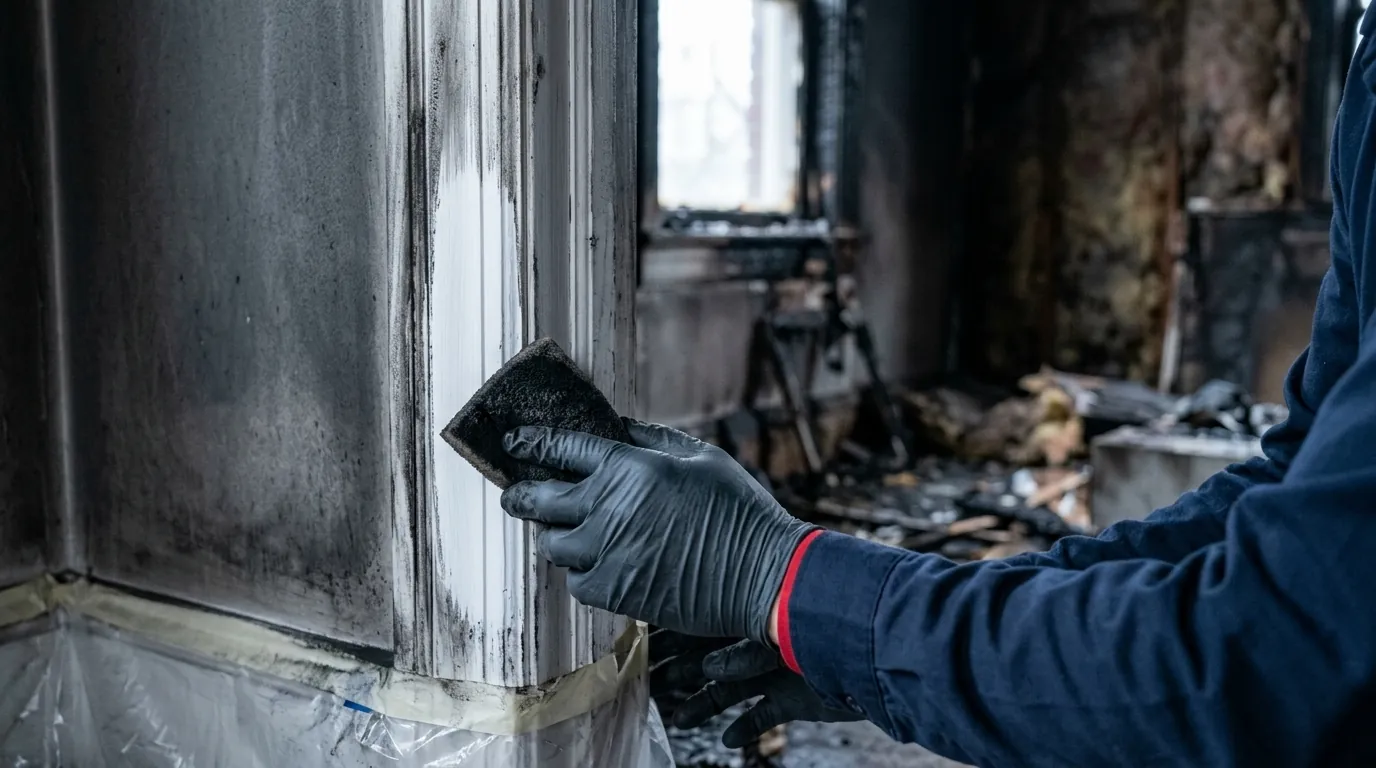
Once the type is confirmed, we pre-treat surfaces with dry chemical sponges on loose soot before introducing any liquid cleaner. Applying a wet cleaner to unsponged soot drives the particles deeper into porous surfaces — a mistake that creates permanent staining. After dry removal, we apply pH-balanced cleaning solutions appropriate to the surface: different formulas for painted drywall, wood trim, brick, and fabric. HVAC registers and ductwork are sealed or cleaned depending on how far the smoke migrated.
Odor control runs parallel to surface cleaning. Thermal fogging and hydroxyl generation neutralize smoke molecules that have bonded to materials rather than just sitting on top of them. In homes with finished basements — which describes the majority of properties we work in throughout Cranberry Township — we pay particular attention to stairwells and lower-level HVAC equipment, where smoke stratifies and settles.
Reaching Any Part of Cranberry Township Around the Clock
FireDEX Butler’s shop is on Marshall Road, which puts us inside Cranberry Township before most contractors from Pittsburgh have merged onto I-79. Whether the call comes from a home near Cranberry Commons, a property backing up to Graham Park, or a newer build in the Park Place development, our crews are on the road quickly. We respond 24/7, so a fire at 2 a.m. gets the same mobilization as one at noon. Fire damage doesn’t pause while you wait for business hours, and neither do we.
Insurance Documentation for Cranberry Township Claims
Most homeowner policies in Butler County cover fire and smoke damage, but the documentation requirements vary by carrier. We photograph affected surfaces before, during, and after cleaning, catalog damaged contents, and provide a written scope of work formatted to align with standard insurance claim language. If your adjuster needs to walk the property, we coordinate that visit. Carriers active in the Cranberry Township market — including those handling a high volume of newer construction claims in the Route 19 and Route 228 corridor developments — are familiar with our documentation format, which helps move claims through without supplemental requests.
Local Note
In Cranberry Township’s newer subdivisions, including several built in the Ehrman Farms and Glen Eden areas, builders commonly used a textured spray finish — sometimes called orange peel or knockdown — on ceilings and upper walls. This texture traps soot in its peaks and valleys in a way that flat-painted surfaces do not. Standard wiping misses the recessed areas entirely. We’ve learned to treat these ceilings with a foam-applied cleaner and a soft-bristle detailing process rather than a cloth wipe, which dramatically reduces the number of surfaces that need repainting after cleanup. It’s a small adjustment that saves homeowners a meaningful amount on post-remediation painting costs.
If your Cranberry Township home has smoke or soot damage — whether from a contained kitchen fire or a larger loss — call FireDEX Butler at (724) 452-7400. We’ll assess the full extent of the residue, walk you through the cleaning sequence, and get your home back to a livable condition without shortcuts.
Soot Removal in Cranberry Township: Service Coverage
Frequently Asked Questions
How fast can you arrive for soot removal in Cranberry Township?
How quickly can FireDEX Butler reach a home in the Fox Run or Ehrman Farms area after a fire?
Does the older plaster construction in Fernway homes require a different soot cleaning approach?
My home in the 16066 ZIP code has an open floor plan — will soot have spread beyond the room where the fire started?
What type of soot is hardest to remove, and is it common in Cranberry Township residential fires?
Will my homeowner's insurance cover soot removal for a kitchen fire in Cranberry Township, and how does FireDEX handle the claim?
Soot Removal response in Cranberry Township
Most Cranberry Township calls see a technician on-site within 60 minutes from our Cranberry Township headquarters.