Storm Damage Restoration in Cranberry Township
24/7 storm damage restoration in Cranberry Township and surrounding areas. Insurance billing accepted. Call (724) 452-7400.
A storm moves through fast. The damage it leaves behind does not. A single line of severe weather can drive water through a compromised roof within minutes, drop a tree onto a load-bearing wall, and scatter debris across three floors — all before you have a chance to call anyone. What happens in the first few hours after that determines whether you’re looking at a contained repair or a months-long reconstruction project.
What storm damage restoration actually involves
Storm damage is rarely one problem. It’s a cascade. Wind peels back flashing or lifts shingles, rain follows the opening, and by the time you notice the ceiling stain, water has already traveled through insulation, along joists, and into wall cavities. Tree strikes add structural complexity — a limb through a roof doesn’t just create a hole, it can shift rafters, crack ridge boards, and leave embedded wood fibers that hold moisture for weeks.
Restoring a storm-damaged property means addressing every layer of that cascade: emergency stabilization to stop active intrusion, water extraction and drying to prevent secondary damage, structural assessment to catch what isn’t visible from the ground, and ultimately the repair or reconstruction work that brings the building back to pre-loss condition. The equipment involved ranges from industrial tarps and plywood for board-ups, to truck-mounted extractors, desiccant dehumidifiers, and thermal imaging cameras that locate moisture behind intact drywall.
Timeline depends on severity. A straightforward roof tarp and interior dry-out on a single-story home may take three to five days of active drying. A tree strike with structural damage and significant water intrusion can run two to four weeks before reconstruction even begins.
Our process
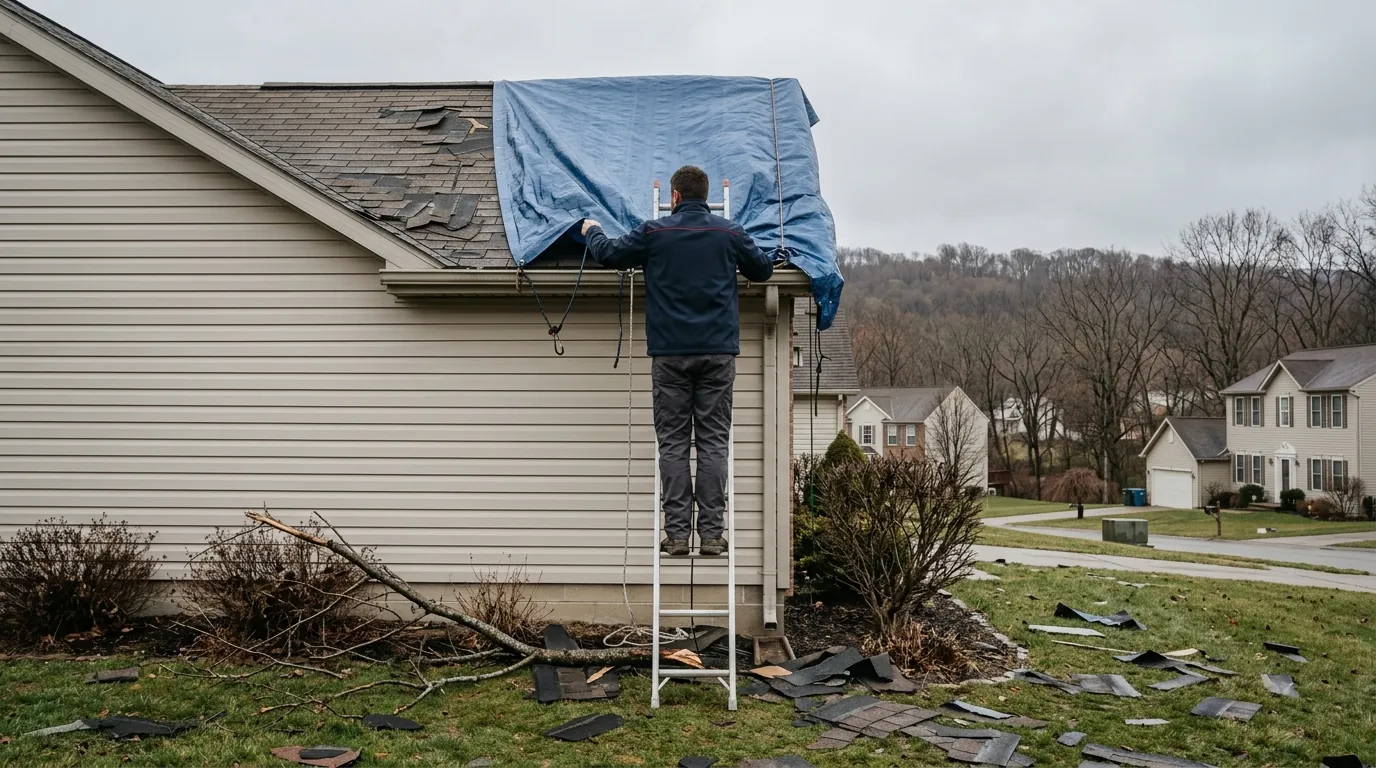
1. Emergency stabilization The first priority is stopping the weather from continuing to enter the building. That means roof tarping, window and door boarding, and temporary shoring if a structural member has been compromised. We document the pre-mitigation condition thoroughly — photos, moisture readings, and written notes — because this record is the foundation of your insurance claim.
2. Damage assessment and moisture mapping Once the structure is stabilized, we conduct a systematic inspection using thermal imaging and pin-type moisture meters to map exactly where water has traveled. Storm water often hides: it pools in wall cavities, saturates subfloor layers, and wicks up bottom plates. Skipping this step is how secondary mold colonization starts — mold can begin developing on wet organic material within 24 to 48 hours of a moisture event.
3. Water extraction and structural drying Standing water comes out first with truck-mounted or portable extractors. Then we set a drying system — commercial-grade air movers and low-grain refrigerant or desiccant dehumidifiers — sized to the affected square footage and material types. We monitor daily, logging temperature, relative humidity, and material moisture content until everything reaches documented dry standard.
4. Debris removal and selective demolition Debris from tree strikes, blown-in material, and storm-damaged building components gets removed and disposed of properly. Where building materials are too saturated to dry in place — certain insulation types, heavily compromised drywall — we perform targeted demolition to expose cavities and allow drying to complete. Nothing gets closed back up until moisture readings confirm it’s ready.
5. Reconstruction and final documentation Once the structure is dry and stable, reconstruction begins: framing repairs, roofing, drywall, insulation, and finishing work. We carry license #PA001913 and coordinate directly with your insurance carrier throughout, providing the scope of work, photo documentation, and moisture logs adjusters need to process the claim.
What separates a good storm damage response from a bad one
The most common failure point is incomplete moisture mapping after the visible damage is addressed. A contractor who patches the roof and calls it done — without verifying what the water did inside — leaves a mold problem waiting to happen. Insurance adjusters increasingly look for documented dry-standard readings, not just a visual inspection, before approving closure on a water-intrusion claim.
A second common miss is structural assessment after tree strikes. The visible damage is obvious; the transferred load isn’t. A limb that punches through a roof can rack a wall section or crack a ridge board in a way that isn’t apparent until the next heavy snow load. Experienced storm restoration operators probe beyond the impact zone.
Finally, documentation quality matters more than most homeowners realize. Adjusters work from the record you give them. Vague descriptions and a handful of photos produce underpaid claims. Detailed moisture logs, thermal images, and itemized scope of work produce accurate ones.
Seasonal and regional considerations
Western Pennsylvania’s storm season runs roughly April through October, with the highest frequency of severe weather — hail, straight-line winds, and occasional tornado-warned cells — concentrated in late spring and early summer. The Pittsburgh metro corridor, including Cranberry Township and Butler County, sits in a zone where warm Gulf air collides with cooler systems moving down from the Great Lakes, producing fast-moving storms that can drop significant wind and hail with limited warning.
Fall storms in this region carry a secondary risk: wet leaves and debris accelerate shingle granule loss and clog gutters, driving water back under fascia and into soffits. Winter storm damage — ice dams, snow load failures, freeze events after a roof breach — requires a different response than summer wind and rain events, particularly around preventing pipe damage in exposed wall cavities.
Service area
FireDEX Butler is based in Cranberry Township and serves property owners throughout the surrounding region, including Butler, Mars, Wexford, Zelienople, Evans City, and communities across Butler and northern Allegheny counties. The city-specific pages linked from this service cover detailed local information for each area.
If a storm has hit your property and you’re not sure where to start, call (724) 452-7400. We’re available around the clock, and the first step — stopping further intrusion and getting eyes on the damage — doesn’t have to wait until morning.
Frequently Asked Questions
My roof was breached during a storm but the rain has stopped. Do I still need emergency tarping right away?
A tree came down on my house. How do you determine whether the structure is safe to occupy while repairs are underway?
What does 'documented dry standard' mean, and why does my insurance adjuster keep asking about it?
How do I know if my property has hidden water damage after a storm, even if I don't see any staining or wet surfaces?
What's the difference between hail damage and wind damage on a roof, and does it matter for my claim?
Looking for the best storm damage restoration company in Cranberry Township?
FireDEX Butler provides licensed and insured storm damage restoration in Cranberry Township, PA and the surrounding area, and has served local property owners since 1981. We answer calls 24/7 — call (724) 452-7400 for immediate help.
Need Storm Damage Restoration now?
We respond 24/7 across Cranberry Township and surrounding PA cities.
Related Coverage
- Our Restoration Services
- Contact FireDEX Butler
- Storm Damage Restoration in Beaver Falls
- Storm Damage Restoration in Butler
- Storm Damage Restoration in Cranberry Township
- Storm Damage Restoration in Evans City
- Storm Damage Restoration in Gibsonia
- Storm Damage Restoration in Mars
- Storm Damage Restoration in Seven Fields
- Storm Damage Restoration in Wexford
- Storm Damage Restoration in Zelienople
- Storm Damage Insurance Claim Checklist (Use This Before You Call Your Insurer)