Mold Inspection and Testing in Beaver Falls
24/7 mold inspection and testing in Beaver Falls, PA. Insurance billing accepted. Call (724) 452-7400.
Our technicians are dispatched from our Cranberry Township, PA headquarters and are typically on-site in Beaver Falls within 60 minutes of your call.
Stone foundations, river-valley air, and a housing stock that predates the Korean War make Beaver Falls one of the more mold-prone communities in Beaver County. The same cast-iron drains and galvanized supply lines that run beneath College Hill rowhouses and the numbered-avenue frame homes near Geneva College are prone to slow seeps and seasonal condensation — the kind of chronic, low-level moisture that feeds mold colonies for months before a visible patch ever appears on a wall. If you’ve noticed a musty smell in your basement or a family member’s allergies have worsened since a wet season, a professional mold inspection and testing visit is the right first step.
Why Beaver Falls Properties See Elevated Mold Risk
The Beaver River corridor creates a persistent humidity envelope, particularly in the warmer months when dew points climb and river-bottom air settles into low-lying neighborhoods. Homes with stone or poured-block foundations — common throughout the numbered avenues and the older sections of Patterson Township — absorb ground moisture through capillary action rather than a single dramatic leak. That slow infiltration keeps relative humidity in crawl spaces and unfinished basements above 60 percent for weeks at a time, which is all mold needs to establish a foothold.
Aging mechanical systems compound the problem. Original galvanized supply lines corrode from the inside out, producing pinhole leaks inside wall cavities that go undetected for years. Furnaces and space heaters cycling hard through a Pittsburgh-area winter create temperature differentials that cause condensation on cold exterior walls and rim joists — exactly the surfaces where Cladosporium and Penicillium species colonize first. Pre-war brick construction along the Seventh Avenue business district adds a commercial dimension: parapet walls and aging flat roofs funnel water into structural cavities during freeze-thaw cycles, and a single sprinkler discharge can saturate a masonry wall assembly that takes weeks to dry without intervention.
Our Mold Inspection and Testing Process in Beaver Falls
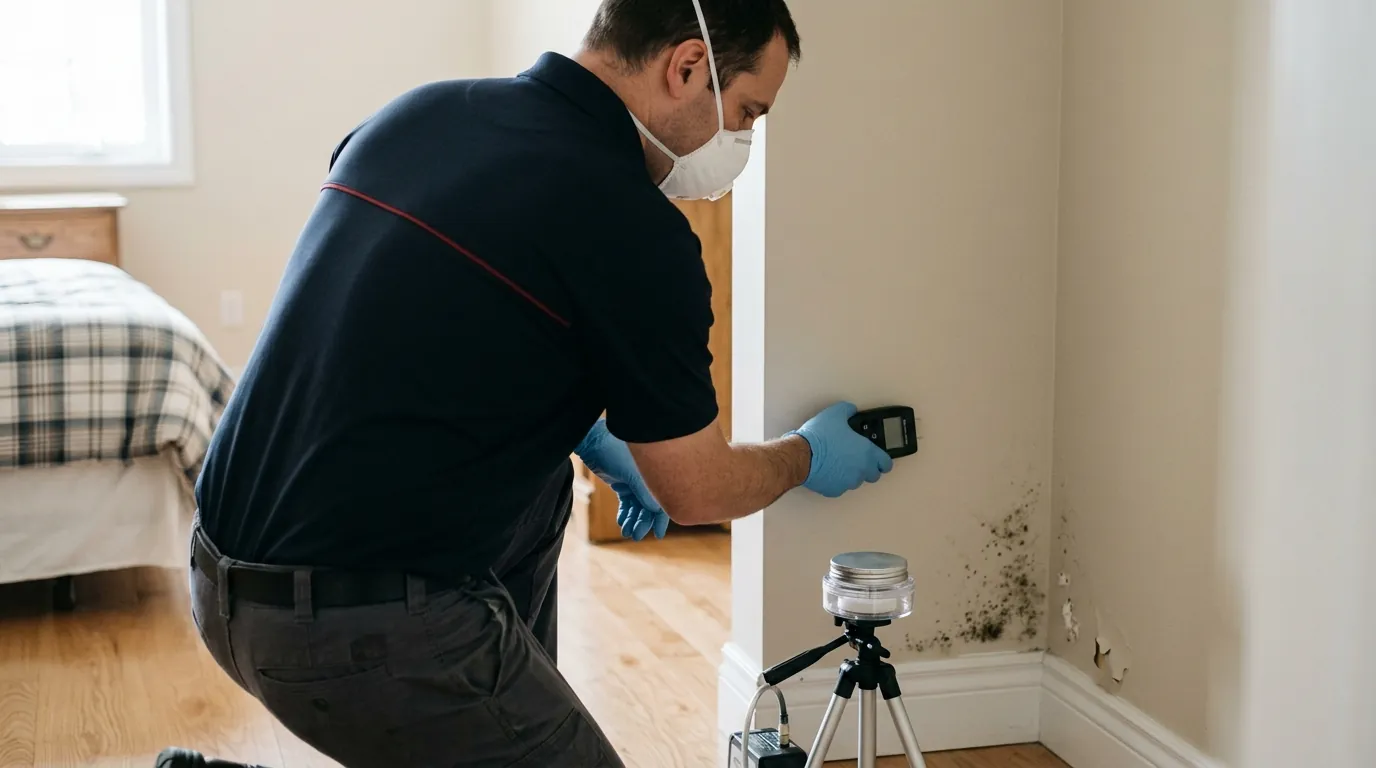
A mold assessment is not a visual walk-through. When a FireDEX Butler inspector arrives at a 15010 address, the process starts with a moisture mapping phase — using thermal imaging and calibrated moisture meters to locate elevated readings behind finished surfaces, under flooring, and inside wall assemblies without cutting into anything unnecessarily. Older plaster-and-lath construction, which is widespread on College Hill, holds moisture differently than modern drywall: the substrate stays wet longer and can harbor mold behind intact paint that looks perfectly dry to the eye.
Once moisture sources are mapped, air sampling and surface sampling establish what species are present and at what concentrations. Air cassettes are pulled from the suspect area and from an unaffected control zone — typically a room on the opposite side of the house — so the lab results reflect the actual delta rather than ambient outdoor spore counts. Swab or tape-lift samples from visible growth give the lab a direct culture to work from. All samples are sent to an accredited third-party laboratory; results typically return within 24 to 48 hours. The written report identifies species, spore counts, probable moisture source, and recommended scope of remediation if warranted — documentation that holds up with insurance adjusters and real estate transactions alike.
Reaching Beaver Falls from Cranberry Township
FireDEX Butler operates around the clock from its Cranberry Township base. The most direct route to Beaver Falls runs west on Route 228 to Route 68, then north through Brighton Township to the Route 18 corridor — a drive that typically runs about 25 minutes under normal conditions. For calls in the Eastvale section near the river or the Patterson Township side of the county, the team can also route via I-76 west depending on traffic. Because the inspection process involves laboratory sampling rather than emergency extraction equipment, the priority on arrival is a thorough assessment rather than speed alone — but calls placed to (724) 452-7400 are answered any hour, and same-day scheduling is the standard, not the exception.
Local Note: What Inspectors Watch for in Beaver Falls Basements
One pattern that shows up repeatedly in Beaver Falls homes is mold growth concentrated at the base of the rim joist — the framing member that sits on top of the foundation wall and supports the first floor. In the river-valley climate, that zone stays cold in winter and humid in summer, and it is almost never insulated in pre-1960 construction. Inspectors probe that area specifically on every Beaver Falls job, because homeowners rarely see it and contractors rarely mention it during a routine home inspection. Finding mold there early, before it migrates into floor-system framing, is the difference between a contained remediation and a structural repair project.
If you’re in Beaver Falls and something in your home smells off after a wet season or a plumbing incident, call FireDEX Butler at (724) 452-7400. A mold inspection and testing visit gives you documented answers — not guesswork — about what’s growing, where it started, and what it will take to clear it.
Mold Inspection and Testing in Beaver Falls: Service Coverage
Frequently Asked Questions
How fast can you arrive for mold inspection and testing in Beaver Falls?
Are College Hill homes in Beaver Falls more prone to mold than newer construction elsewhere in Beaver County?
How does the Beaver River's humidity affect indoor air quality testing results in Beaver Falls?
What does a mold inspection typically involve in a Beaver Falls home with original plaster walls?
Will a mold inspection report from FireDEX Butler satisfy a real estate transaction or insurance claim in the 15010 ZIP code?
Can mold behind a finished wall in a Beaver Falls basement go undetected for years?
Mold Inspection and Testing response in Beaver Falls
Most Beaver Falls calls see a technician on-site within 60 minutes from our Cranberry Township headquarters.