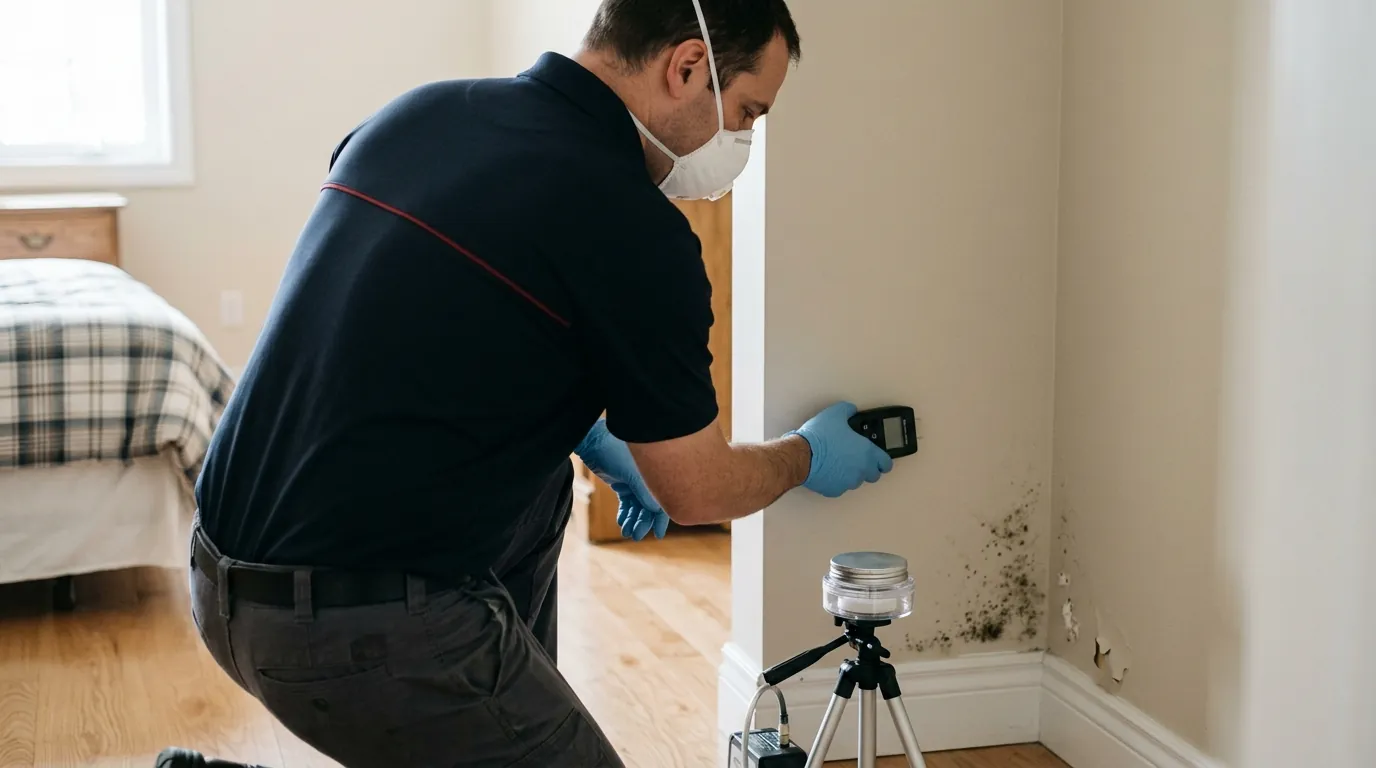
Mold Inspection and Testing in Cranberry Township
24/7 mold inspection and testing in Cranberry Township, PA. Insurance billing accepted. Call (724) 452-7400.
Our technicians are headquartered right here in Cranberry Township and are typically on-site within 60 minutes of your call.
Cranberry Township’s heavy clay soils hold moisture long after a storm passes, and when Brush Creek drainage backs up during a summer cloudburst or a sump pump gives out during spring thaw, that water doesn’t just dry on its own — it migrates into wall cavities, under finished flooring, and behind drywall where mold can begin colonizing within 24 to 48 hours. If you’re in the 16066 ZIP code and you’ve noticed a musty odor, visible discoloration, or unexplained allergy symptoms that ease up when you leave the house, a professional mold inspection and testing assessment is the only way to know what you’re actually dealing with.
Why Cranberry Township Homes Are Particularly Prone to Hidden Mold
Butler County’s fastest-growing township sits at a geographic crossroads that creates a specific set of moisture conditions. The I-79 and Pennsylvania Turnpike interchange funnels commuters through a community where nearly every home — from the 1960s ranch-style plats in Fernway to the two-story colonials built through the 2010s in Fox Run and Ehrman Farms — has a finished or semi-finished basement. That basement is almost always the first place mold takes hold.
The clay-heavy soil surrounding foundations doesn’t drain quickly. During wet springs, hydrostatic pressure pushes seepage through block and poured-concrete walls even when no obvious crack is visible. Older homes in Fernway carry galvanized supply lines that are at or past their service life — pinhole leaks inside walls can go undetected for months. Newer construction in developments along the Route 19 and Route 228 corridor tends to see second-floor bathroom supply failures and washing-machine hose blowouts that soak finished lower levels before anyone realizes there’s a problem. January polar snaps add burst copper lines to the list. Each of these events, if not dried completely and quickly, becomes a mold event.
Our Mold Inspection and Testing Process in Cranberry Township
A mold inspection is not a visual walkthrough with a flashlight. The process starts with a structured interview about the property’s moisture history — past flooding, plumbing repairs, roof leaks, HVAC condensation issues — because that history tells us where to look first. We then conduct a room-by-room physical inspection using moisture meters and thermal imaging to identify elevated readings inside walls and under flooring without tearing anything open unnecessarily.
When the inspection identifies suspect areas, mold spore testing follows. Air sampling is collected from the affected zones and from an outdoor control location, then sent to an accredited third-party laboratory. Surface swab or tape-lift samples are taken when visible growth is present. The lab results quantify spore types and concentrations, which tells you whether what you’re seeing is common environmental mold or a species — like Stachybotrys or Chaetomium — that warrants more aggressive remediation. You receive a written report with findings, lab data, and a clear scope of what needs to happen next.
Because FireDEX Butler has operated out of Cranberry Township since 1981 and our shop sits on Marshall Rd, we’re not driving in from another county. Indoor air quality testing appointments in Cranberry Township are scheduled promptly, and if an inspection uncovers conditions that need immediate attention, the same team can transition directly into remediation work.
What to Expect After Testing: Cranberry Township Insurance Coordination
Mold claims in Pennsylvania can be complicated. Many homeowners insurance policies cover mold only when it results from a covered water loss — a burst pipe, an appliance failure, a sudden roof leak — and deny claims tied to long-term seepage or humidity. The written inspection report and laboratory results we provide are the documentation your carrier needs to evaluate the claim. We photograph affected materials, note moisture readings at the time of inspection, and document the probable moisture source in a format adjusters recognize.
If your policy does cover remediation, we bill carriers directly and walk you through the process. FireDEX Butler holds Pennsylvania Home Improvement Contractor Registration (#PA001913), so the paperwork is in order from the start.
Local Note
One pattern we see consistently in Cranberry Township’s 1990s and early 2000s construction — particularly in developments near Cranberry Heights and Park Place — is mold growth behind shower surrounds on exterior walls. Builders of that era often installed fiberglass tub surrounds directly against exterior framing with minimal vapor management. When grout lines fail or caulk shrinks, water wicks into the wall assembly and sits against OSB sheathing that never fully dries. Homeowners often assume the musty smell is coming from the basement when the actual source is a second-floor bathroom wall. A thorough mold assessment in these homes always includes the bathroom envelope, not just the lower level.
If you’ve had any water event in your Cranberry Township home — or if you’re buying a property and want a pre-purchase mold assessment before closing — call FireDEX Butler at (724) 452-7400. We’ll tell you exactly what’s there, what it means, and what it takes to resolve it.
Mold Inspection and Testing in Cranberry Township: Service Coverage
Frequently Asked Questions
How fast can you arrive for mold inspection and testing in Cranberry Township?
Are finished basements in Cranberry Township's newer developments more vulnerable to mold after a sump pump failure?
How soon after a water event in Cranberry Township should I schedule mold testing?
I'm buying a home in the 16066 ZIP code — can FireDEX Butler do a pre-purchase mold assessment before closing?
What types of mold are typically found in Cranberry Township homes, and does the species matter?
Does Cranberry Township's clay soil affect mold risk differently than other parts of Butler County?
Will my homeowners insurance cover mold inspection and testing in Cranberry Township?
Mold Inspection and Testing response in Cranberry Township
Most Cranberry Township calls see a technician on-site within 60 minutes from our Cranberry Township headquarters.