Mold Inspection and Testing in Cranberry Township
24/7 mold inspection and testing in Cranberry Township and surrounding areas. Insurance billing accepted. Call (724) 452-7400.
You notice a musty smell in the basement every time it rains, or a dark stain creeping along the drywall behind the washing machine. Maybe someone in the house has been waking up with congestion that clears up when they leave for work. These are the kinds of signals that bring people to a mold inspection — not a visible green bloom, but something quieter and harder to pin down. A proper mold inspection and testing protocol answers the question you actually need answered: is there active mold growth, where is it, how far has it spread, and what species are present?
What mold inspection and testing actually involves
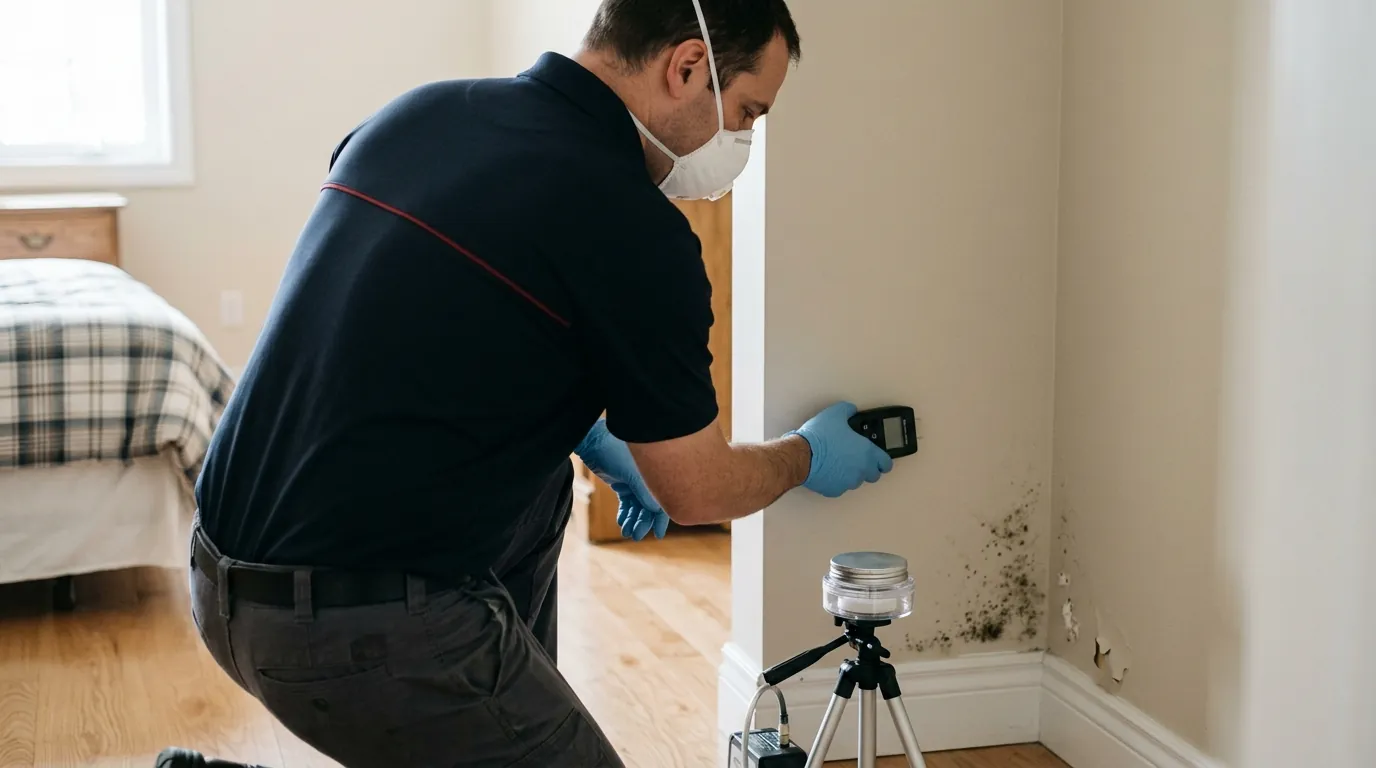
A mold inspection is not a walk-through with a flashlight. It starts with a structured visual assessment of the building envelope — crawl spaces, attic sheathing, wall cavities around plumbing penetrations, HVAC air handlers, and anywhere moisture has historically intruded. Inspectors use calibrated moisture meters and thermal imaging cameras to find elevated readings behind surfaces that look dry to the eye. Wet drywall at 18% moisture content can begin supporting mold colonization within 24 to 48 hours of a water event; by the time a stain is visible, growth has often been active for weeks.
Air sampling is the testing component. Spore trap cassettes are placed at strategic locations — typically one outdoor baseline sample and two or more indoor samples in areas of concern — and run for a timed volume of air using a calibrated pump. Those cassettes go to an accredited third-party laboratory, which returns a spore count and genus identification, usually within 3 to 5 business days. Surface sampling (tape lifts or swabs) is added when there is a visible suspect material that needs species confirmation. The combination of visual findings, moisture data, and lab results gives you a defensible, documented picture of the indoor air quality conditions in the structure.
Our process
-
Pre-inspection intake and history review. Before arriving on-site, we gather the building’s water-loss history — prior leaks, insurance claims, HVAC service records, any tenant or occupant complaints. Mold problems almost always trace back to a moisture event, and knowing the timeline helps us target the inspection efficiently.
-
Systematic visual and moisture survey. We work through the structure zone by zone, probing suspect materials with pin and pinless moisture meters and scanning walls and ceilings with a thermal camera. Every anomalous reading is photographed and logged with its location.
-
Air and surface sampling. Spore trap air samples are collected at the outdoor baseline and at each zone of concern. Where visible growth or suspect staining is present, we add tape-lift surface samples. Sample chain-of-custody documentation is completed on-site and submitted with the cassettes to the laboratory.
-
Laboratory analysis and report delivery. Results come back from the accredited lab as a spore count per cubic meter of air, broken down by genus (Cladosporium, Aspergillus/Penicillium, Stachybotrys, and others). We compile those results with the moisture survey data and photographic documentation into a written assessment report you can share with your insurance adjuster, a remediation contractor, or a real estate attorney.
-
Findings walkthrough and next-step guidance. We review the report with you in plain language — what the numbers mean, which findings are actionable, and what a remediation scope would need to address. If remediation is warranted, you receive a documented baseline that can be used to verify clearance testing after the work is complete.
What separates a good mold assessment from a bad one
The most common failure in mold inspections is under-sampling. A single air sample in the room with the visible stain tells you almost nothing without an outdoor baseline and samples from adjacent spaces — mold spores migrate through HVAC systems and wall cavities, and a single data point cannot characterize the building. A thorough assessment collects enough samples to establish a meaningful comparison between indoor and outdoor spore loads.
The second common failure is skipping moisture mapping. Identifying visible growth without locating the active moisture source means the mold will return after remediation. Insurance adjusters reviewing remediation claims increasingly require documented moisture readings tied to specific building materials, not just a narrative description.
A third issue is conflicts of interest. When the same company performs the inspection and sells the remediation, there is a structural incentive to find problems. FireDEX Butler provides inspection and testing as a documented, reportable service — the findings speak for themselves, and you are not pressured into a remediation scope on the same visit.
Seasonal and regional considerations
Western Pennsylvania’s climate creates predictable mold pressure windows. Humid summers push indoor relative humidity above 60% in homes without properly sized air conditioning, which is enough to sustain mold growth on dust-loaded surfaces even without a visible water intrusion. Crawl spaces under older homes in Butler County and the surrounding townships are especially vulnerable — ground vapor migrates upward through dirt floors, and rim joist insulation installed against unvented masonry holds moisture year-round. Spring snowmelt and the region’s frequent freeze-thaw cycles in late winter also drive water into foundation walls and window wells, creating the kind of slow, intermittent wetting that mold colonizes quietly over months before it becomes visible.
Service area
FireDEX Butler is based in Cranberry Township and serves mold inspection and testing calls throughout Butler County and the surrounding region, including Mars, Wexford, Zelienople, Butler, Evans City, and communities across northern Allegheny County. The city-specific pages for each area link back here for full service details.
If you are smelling something you cannot locate, seeing staining you cannot explain, or dealing with an indoor air quality concern after a water event, call (724) 452-7400 to schedule a mold assessment. We are available around the clock, and we will tell you exactly what the testing shows.
Frequently Asked Questions
What is the difference between a mold inspection and mold testing, and do I need both?
What spore count or genus result should concern me on a lab report?
How should I prepare for a mold inspection, and is there anything I should avoid doing beforehand?
Can a mold inspection report be used to support an insurance claim?
After mold remediation is complete, how do I know the problem is actually resolved?
Looking for the best mold inspection and testing company in Cranberry Township?
FireDEX Butler provides licensed and insured mold inspection and testing in Cranberry Township, PA and the surrounding area, and has served local property owners since 1981. We answer calls 24/7 — call (724) 452-7400 for immediate help.
Need Mold Inspection and Testing now?
We respond 24/7 across Cranberry Township and surrounding PA cities.
Related Coverage
- Our Restoration Services
- Contact FireDEX Butler
- Mold Inspection and Testing in Beaver Falls
- Mold Inspection and Testing in Butler
- Mold Inspection and Testing in Cranberry Township
- Mold Inspection and Testing in Evans City
- Mold Inspection and Testing in Gibsonia
- Mold Inspection and Testing in Mars
- Mold Inspection and Testing in Seven Fields
- Mold Inspection and Testing in Wexford
- Mold Inspection and Testing in Zelienople
- How To Test for Mold in Your Home (DIY Kits vs a Pro Inspection)