Odor Removal and Deodorization in Beaver Falls
24/7 odor removal and deodorization in Beaver Falls, PA. Insurance billing accepted. Call (724) 452-7400.
Our technicians are dispatched from our Cranberry Township, PA headquarters and are typically on-site in Beaver Falls within 60 minutes of your call.
The pre-war brick rowhomes and aging frame houses that line College Hill and the numbered avenues in Beaver Falls hold onto odors the way they hold onto everything else — stubbornly. Cast-iron drain stacks, galvanized supply lines, and decades-old furnaces mean that when a space heater ignites a wall cavity or a sewage line backs up into a basement, the smell doesn’t just linger in the air. It soaks into plaster, settles into mortar joints, and works its way behind original woodwork in ways that a can of spray deodorizer will never touch. FireDEX Butler has been handling losses like these since 1981, and we respond around the clock — because odor problems don’t wait for business hours.
Why Beaver Falls Homes Hold Odors Longer
Beaver Falls sits in a river valley, and the Beaver River’s influence on local humidity is real. Stone and brick foundations common throughout the older neighborhoods trap moisture year-round, and that baseline dampness gives odor molecules — from smoke, sewage, mold, or decomposition — a medium to bond with. When a furnace puffs back smoke through ductwork in a College Hill double, the soot particles don’t just coat surfaces; they migrate into the plaster substrate and the mortar between the brick. The same valley humidity that makes summer evenings heavy on Seventh Avenue also slows the natural off-gassing that would otherwise help a home clear itself over time.
Older commercial properties along the Seventh Avenue business district present their own pattern. Sprinkler discharges in buildings that haven’t been fully updated leave standing water in drop ceilings and behind plaster walls — and within 48 to 72 hours, microbial odor compounds begin forming even if visible mold hasn’t appeared yet. Getting deodorization started before that window closes is the difference between a straightforward treatment and a multi-phase remediation.
Our Odor Removal and Deodorization Process in Beaver Falls
Effective odor removal isn’t a single step — it’s a sequence calibrated to what the structure absorbed and how long it’s been sitting. Here’s how we approach it in Beaver Falls properties:
Source removal first. No deodorization technology works if the odor source is still present. We remove charred materials, contaminated insulation, or saturated flooring before any treatment begins. In the older rowhomes on the numbered avenues, that sometimes means carefully extracting original tongue-and-groove subfloor that has absorbed sewage or smoke rather than trying to treat through it.
Thermal fogging penetrates the same pathways smoke traveled — into wall voids, behind baseboards, through HVAC ductwork. The fogging agent pairs with odor molecules at a chemical level rather than masking them. This is particularly effective in Beaver Falls homes where original plaster walls have absorbed smoke from a kitchen or furnace fire.
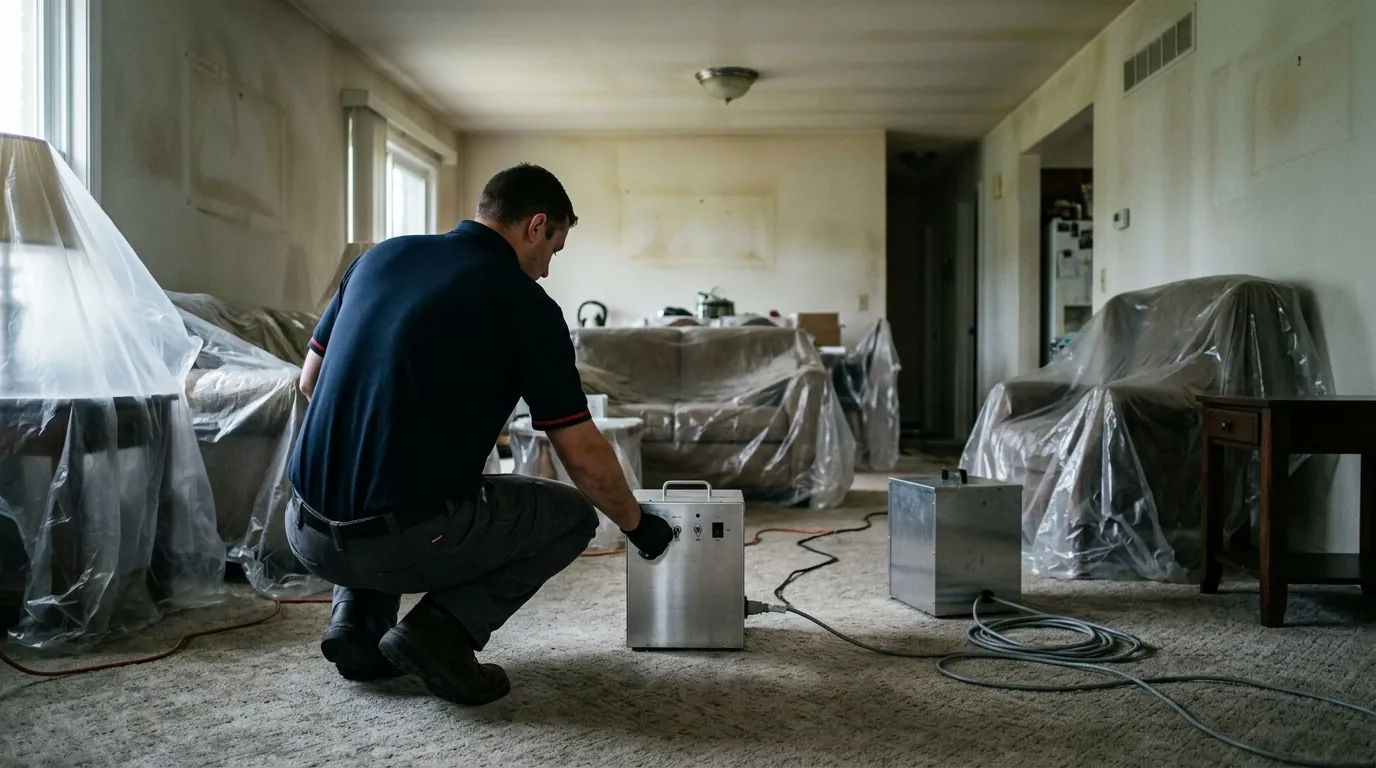
Hydroxyl deodorization runs continuously in occupied or semi-occupied spaces where ozone treatment isn’t safe. Hydroxyl generators produce reactive molecules that break down odor compounds in the air and on surfaces without requiring the building to be vacated for extended periods — useful when a homeowner near Brady’s Run Park needs to get back into part of their house while work continues.
Ozone treatment is reserved for severe cases — heavy smoke odors in vacant structures, or persistent musty odors in unoccupied basement spaces. Ozone is powerful and requires the space to be completely unoccupied during treatment and properly ventilated afterward.
Post-treatment verification closes the job. We don’t sign off on a deodorization based on how the air smells to us after hours of working in it. We air out the space, return, and evaluate with fresh senses — and we document the process for insurance purposes.
Reaching Beaver Falls from Cranberry Township
Our crew operates out of Cranberry Township and reaches Beaver Falls via Route 68 to I-76 west, typically arriving in about 25 minutes under normal conditions. Because we run 24/7, a call at 2 a.m. about smoke odor following a space-heater fire in the 15010 ZIP code gets the same response as a weekday afternoon call. Patterson Township and White Township addresses on the outer edges of the service area add a few minutes, but we cover the full Beaver Falls footprint — from the Geneva College campus to the Route 18 corridor.
Local Note
One thing we’ve learned working in Beaver County mill-town housing: the original cast-iron drain stacks in older Beaver Falls rowhomes often run inside interior wall chases rather than along exterior walls. When a sewage backup sends odor-laden moisture up through a floor drain, it wicks upward inside that wall cavity in ways that aren’t obvious from the surface. We probe those wall chases with a moisture meter before assuming the odor source is limited to the basement level — skipping that step is how a sewage odor job turns into a callback six weeks later when the smell returns from the second floor.
Insurance Coordination
Most odor removal losses in Beaver Falls — smoke from a furnace puffback, sewage backup, fire damage — are covered events under standard homeowner policies. We document affected materials with photographs and written scope before any work begins, submit directly to most major carriers, and can work with your adjuster’s timeline. For commercial property owners along Seventh Avenue managing older buildings, we’re familiar with the documentation requirements that come with sprinkler-discharge and fire-suppression claims.
When you’re standing in a smoke-filled house on College Hill at midnight or dealing with a sewage smell that’s been building in your basement for days, the last thing you need is to coordinate multiple contractors. Call (724) 452-7400 — we handle the odor removal, the documentation, and the insurance communication so you can focus on getting your home back.
Odor Removal and Deodorization in Beaver Falls: Service Coverage
Frequently Asked Questions
How fast can you arrive for odor removal and deodorization in Beaver Falls?
How quickly can FireDEX Butler reach a Beaver Falls address after a smoke or sewage odor call?
Are the older plaster-wall homes on College Hill harder to deodorize after a fire than newer construction?
We had a sewage backup in our Beaver Falls basement and the smell is coming from the walls, not just the floor — is that normal?
What's the difference between ozone treatment and hydroxyl deodorization, and which one applies to my Beaver Falls property?
Will my homeowner's insurance cover professional odor removal after a furnace puffback or space-heater fire in Beaver Falls?
Odor Removal and Deodorization response in Beaver Falls
Most Beaver Falls calls see a technician on-site within 60 minutes from our Cranberry Township headquarters.