Odor Removal and Deodorization in Cranberry Township
24/7 odor removal and deodorization in Cranberry Township, PA. Insurance billing accepted. Call (724) 452-7400.
Our technicians are headquartered right here in Cranberry Township and are typically on-site within 60 minutes of your call.
Cranberry Township’s clay-heavy soil and aggressive freeze-thaw cycles mean that when a sump pump fails during a spring thaw or a burst supply line soaks a finished basement in a Fox Run colonial, the water damage is only half the story. The other half is the odor — musty, sharp, or smoke-tinged — that settles into drywall, carpet padding, and HVAC ductwork long after the visible moisture is gone. FireDEX Butler has operated out of Cranberry Township since 1981, and professional odor removal here means understanding exactly what these homes are made of and how they breathe.
Why Cranberry Township Properties Hold Odors Longer
The township’s housing stock spans nearly six decades of construction, and each era has its own odor-retention profile. Older Fernway plats from the 1960s were built with plaster-and-lath interiors and galvanized supply lines — both of which are reaching end of life. When a galvanized pipe weeps or fails, the slow seepage saturates wall cavities before anyone notices, and the resulting mildew odor embeds in the plaster matrix in a way that surface sprays cannot reach. Newer two-story plans in developments along the Route 19 / Route 228 corridor — built from the 1990s through the 2020s — use engineered wood subfloors and open-cell spray foam insulation that trap smoke and biological odors differently than solid lumber does.
Cranberry Township also sits at an elevation where winter temperature swings are sharp. A January polar snap that freezes a supply line in an uninsulated garage wall can also push combustion odors from a cracked heat exchanger into the living space at the same time. By spring, that same home may be dealing with hydrostatic seepage through the foundation as Brush Creek drainage backs up during cloudbursts, layering a second odor source on top of the first.
Our Odor Removal and Deodorization Process
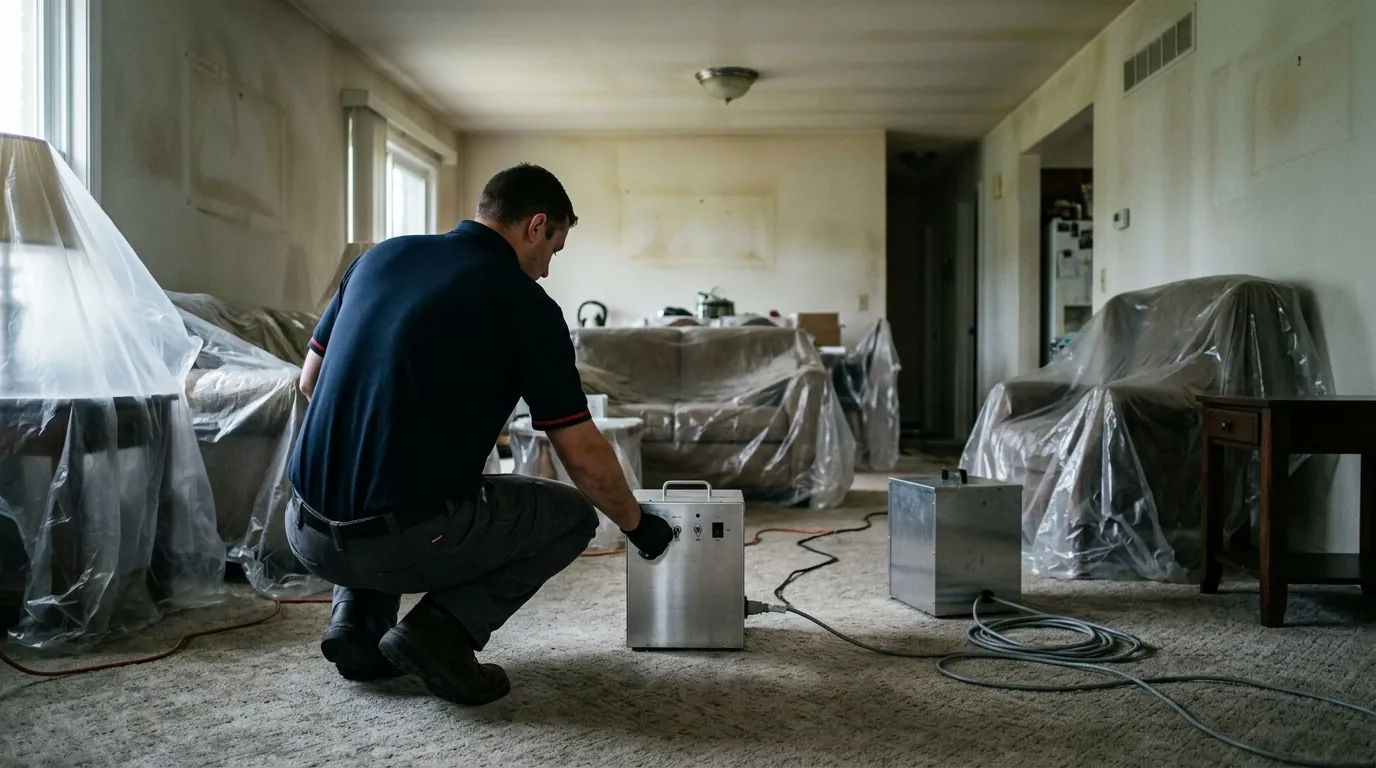
Effective odor elimination is not a single-step treatment — it follows the odor molecule to wherever it has migrated. The process begins with a room-by-room assessment that identifies source materials: charred framing, smoke-coated HVAC registers, water-damaged subfloor, or biologicals left behind by a sewage backup. We document everything with photographs and moisture readings before any equipment is placed.
For smoke odor removal, thermal fogging is often the right tool — a petroleum-based or water-based deodorizer is heated into a fine fog that penetrates the same porous surfaces the smoke particles reached, neutralizing odor at the molecular level rather than masking it. For post-water-damage mold and mildew odors, hydroxyl deodorization is frequently the better choice: hydroxyl generators produce reactive hydroxyl radicals that break down odor compounds continuously over time, and unlike ozone treatment, they can run safely while occupants are present in adjacent spaces. Ozone treatment remains effective for severe smoke odor in unoccupied structures — we use it in sealed, evacuated rooms where the concentration can be held long enough to work.
After active treatment, we verify results with air sampling and surface checks. A job is not complete until the odor is gone at the source, not just reduced at the doorway.
Equipment Calibrated to Cranberry Township Conditions
Humidity is the variable that changes everything about deodorization timelines here. Cranberry Township’s wet springs — when relative humidity inside unventilated basements can exceed 80% — slow the thermal fogging process and reduce the effective radius of hydroxyl generators. We account for this by staging commercial-grade desiccant dehumidifiers alongside odor-treatment equipment, bringing indoor humidity down to a range where deodorization chemistry actually works. Running a hydroxyl generator in a 78% RH basement without dehumidification first is a common shortcut that produces mediocre results; we do not take it.
For homes near the I-79 / Pennsylvania Turnpike interchange where traffic and commercial activity are heavier, diesel exhaust infiltration through foundation cracks is an occasional secondary odor complaint we have seen layered onto fire or water losses. Identifying that source early prevents a second service call.
Local Note
Homes in the Fernway neighborhood present a specific challenge that newer construction does not: original 1960s-era plaster walls absorb odor compounds more deeply than modern drywall, and they release them more slowly during treatment. A thermal fogging cycle that clears a 2005-built home in four hours may need to run twice in a Fernway plaster-wall house to reach the same result. We factor that into the scope estimate upfront so there are no surprises on the second visit — and so insurance documentation reflects the actual labor required rather than a generic square-footage formula.
If you are in the 16066 ZIP code and dealing with a persistent smell that has not responded to consumer-grade products, the issue is almost certainly in a substrate that requires professional-grade equipment and chemistry to reach.
Call FireDEX Butler at (724) 452-7400. We are available around the clock, and our shop on Marshall Rd means Cranberry Township addresses are among the fastest we reach. Odors do not improve with time — the longer smoke residue or mold off-gassing sits in a wall cavity, the deeper it penetrates.
Odor Removal and Deodorization in Cranberry Township: Service Coverage
Frequently Asked Questions
How fast can you arrive for odor removal and deodorization in Cranberry Township?
How quickly can FireDEX Butler reach a home in the Fox Run or Fernway area for an odor emergency?
Are finished basements in Cranberry Township's newer developments harder to deodorize after a sump-pump failure?
Does Cranberry Township's high spring humidity affect how long ozone or hydroxyl treatment takes?
What deodorization method works best for smoke odor in an older Cranberry Township home with plaster walls?
Will my homeowner's insurance cover professional odor removal after a fire or water loss at my Cranberry Township property?
Odor Removal and Deodorization response in Cranberry Township
Most Cranberry Township calls see a technician on-site within 60 minutes from our Cranberry Township headquarters.